Incomplete dominance (1:2:1), Biology

Assignment Help:

INCOMPLETE DOMINANCE (1:2:1)

Sometimes two genes of allelomorphic pair do not show dominant-recessive relationship, but when present simultaneously (or come together), they show intermediate condition or blend together, which is called incomplete dominance. It is due to the fact that the dominant character or gene is not in a position to completely suppress the recessive one. With the result, the heterozygote has a different phenotype (as well as different genotype) from homozygous for either allele.

  • First case of incomplete dominance was reported in Mirabilis jalapa (4 o'clock plant) by Carl Correns (1903).

Incomplete dominance is found in both plants and animals. Good examples are seen in Mirabilis jalapa, Antirrhinum majus, (snapdragon) and Andalusian fowl.

Example :- 1

In Mirabilis jalapa (4 o'clock plant) and Antirrhinum majus (Snapdragon or Dog flower) there are two types of flower colour in pure state, red and white.

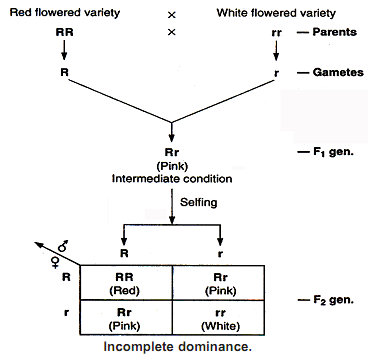
A cross between a plant pure for red flowers and a plant pure for white flowers yield hybrid plants with pink flowers in F1 generation. Neither red nor white is completely dominant, so that both colour appear in the hybrids as a blend which is pink. This is obviously a contradiction of Mendel's assumption that no blending of characters takes place. When two of the hybrid plants with pink flowers are crossed, the F2 generation includes plants with red, pink and white flowers in the usual Mendelian ratio of 1 : 2 : 1.
1584_incomplete dominance.png

Incomplete dominance.

This cross shows :-

(i)         Incomplete dominance.

(ii)         The genes for red and white colour do not actually mix in the F pink hybrids as both the pure characters (red and white) reappear in the F1 plants.

(iii)        There is no specific gene for pink flowers.

(iv)        Quantitative effect of genes. The homozygous plants rr are unable to produce the flower pigment. The heterozygous plants Rr can produce only half the amount of flower pigment that is produced by the homozygous plant RR. In the F2 generation of the above cross :-

(i)         The genotypic ratio is the same as Mendelian ratio, being 1 : 2 : 1 (1 RR : 2 Rr : 1 rr).

(ii)         The phenotypic ratio differs from the Mendelian ratio, also being 1 : 2 : 1 (red : pink : white) instead of 3 : 1 (red : white).

(iii)        Half of the F2 generation show F1 phenotype instead of 3/4. 

The phenotypic Fratio of 1 : 2 : 1 is characteristics of incomplete dominance.

Example :- 2

Incomplete dominance is also found in Andalusian fowl. The Andalusian fowl is found in three colours : Black, white and blue. Pure forms are black (BB) and white (bb). If these two forms are crossed, F1 individuals appear blue (Bb) coloured. The blue hybrids on crossing with each other (Bb, Bb) give rise to one black (BB), two blue (Bb) and one white (bb) in 1 : 2 : 1 ratio. The blue appearance of the hybrids is due to very fine alternating white and black strips on the feathers.


Related Discussions:- Incomplete dominance (1:2:1)

Role of protein in metabolism, ROL E OF PROTEIN - Main organic comp...

ROL E OF PROTEIN - Main organic component of body. Unit is amino acid. Polymer of amino acids. Amino acids combine to each other by peptide bond. Formation of bone, t

Why are broad-spectrum antibiotics used to treat infections, Why are broad-...

Why are broad-spectrum antibiotics often used to treat infections caused by unidentified pathogens? What is the danger associated with overusing such antibiotics? As broad-spec

Calculate the insulin bolus and drip rate , Mrs. M is a 35-year-old Hispani...

Mrs. M is a 35-year-old Hispanic female with no known past medical history; does not have a primary care provider (PCP). She presents to the emergency department with the following

Types of parthenogenesis, TYPES OF PARTHENOGENESIS - 1 .      NATURAL...

TYPES OF PARTHENOGENESIS - 1 .      NATURAL PARTHENOGENESIS - In many animals natural parthenogenesis is common process & is a method of reproduction. It is of two typ

Lymph, LYMPH - Lymph is a mobile connective tissue comprising lymph pla...

LYMPH - Lymph is a mobile connective tissue comprising lymph plasma (fluid) and lymphcorpuscles (cells).   COMPOSITIO N - (i )      Lymph Plasma - It is simil

Why the depicted food web is not complete, The depicted food web is not com...

The depicted food web is not complete, mainly because:  a. The number of producers is less than the number of consumers. b. There are no decomposers. c. Only secondary co

Lakes - lentic ecosystems, Lakes - Lentic Ecosystems Most lakes occur...

Lakes - Lentic Ecosystems Most lakes occur in regions which have recently been subjected to geological changes; say within the past 20,000 years. However, a few lakes, such a

What are the phytoplankton and the zooplankton?, What are the phytoplankton...

What are the phytoplankton and the zooplankton? The Phytoplankton and the zooplankton are divisions of the plankton. The phytoplankton includes the autotrophic floating beings:

Pathophysiology and assessment of patent ductus arteriosus, Pathophysiology...

Pathophysiology   If  the ductus arteriosus does not close after birth, the higher pressure in the aorta than in the pulmonary artery causes the blood to flow from the aorta, t

Cnidaria and protozoan, What are the advancement of cnidaria over protozoa

What are the advancement of cnidaria over protozoa

Write Your Message!

Captcha
Free Assignment Quote

Assured A++ Grade

Get guaranteed satisfaction & time on delivery in every assignment order you paid with us! We ensure premium quality solution document along with free turntin report!

All rights reserved! Copyrights ©2019-2020 ExpertsMind IT Educational Pvt Ltd