Implementation of queue, Data Structure & Algorithms

Assignment Help:

For a queue a physical analogy is a line at booking counter. At booking counter, customers go to the rear (end) of the line & customers are attended to several services from the front of the line. Unlike stack, customers are inserted at the rear end & deleted from the front end into a queue (FIFO).

In computer science, an instance of the queue is print jobs scheduled for printers. These jobs are maintained into a queue. The job fired for the printer first gets printed first. Similar is the scenario for job scheduling in the CPU of computer.

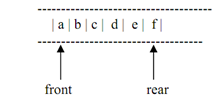
Like a stack, usually a queue also holds data elements of the similar type. Usually We graphically display a queue horizontally. Figure demonstrates a queue of 5 characters.
2141_IMPLEMENTATION OF QUEUE.png

        Figure: A queue of characters

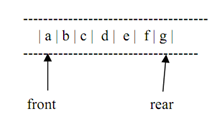
In a queue the rule followed is that elements are inserted at the rear & come off of the front of the queue. After the insertion of an element to the above queue, the position of rear pointer alters as illustrated below. Now the rear is pointing to the new element 'g' added at the rear of the queue.
1597_IMPLEMENTATION OF QUEUE1.png

Figure: Queue of above figure after addition of new element

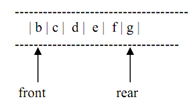
After the elimination of element 'a' from the front, the queue alters to the following along with the front pointer pointing to 'b'.
705_IMPLEMENTATION OF QUEUE2.png

Figure: Queue of figure 5.2 after deletion of an element

Algorithm for insertion of an element to the queue

Step 1: Create a new element to be inserted

Step 2: If the queue is empty, then go to

Step 3, else perform step 4

Step 3: Make the front & rear point this element

Step 4: Insert the element at the end of the queue and shift the rear pointer to the lately added element.

Algorithm for deletion of any element from the queue

Step 1: verify for Queue empty condition. If queue is empty, then go to step 2, else go to step 3

Step 2: Message "Queue Empty"

Step 3: Delete the element through the front of the queue. If in the queue it is the last element, then carry out step a else step b

a) make front & rear point to null

b) Shift the front pointer further on to point to the next element in the queue


Related Discussions:- Implementation of queue

Algorithm, implement multiple stacks in a single dimensional array. write a...

implement multiple stacks in a single dimensional array. write algorithm for various stack operation for them

Binary tree traversals, We have discussed already about three tree traversa...

We have discussed already about three tree traversal methods in the earlier section on general tree. The similar three different ways to do the traversal -inorder , preorder, and p

Exact analysis of insertion sort, Exact analysis of insertion sort: Let...

Exact analysis of insertion sort: Let us assume the following pseudocode to analyse the exact runtime complexity of insertion sort. T j   is the time taken to execute the s

Simulation of queues, Simulation is the process of making an abstract model...

Simulation is the process of making an abstract model of a real world situation in order to be aware of the effect of modifications and alterations and the effect of introducing nu

Explain merge sort, Merge sort: Merge sort is a sorting algorithm that ...

Merge sort: Merge sort is a sorting algorithm that uses the idea of split and conquers. This algorithm splits the array into two halves, sorts them separately and then merges t

Accept a file and form a binary tree - huffman encoding, Huffman Encoding i...

Huffman Encoding is one of the very simple algorithms to compress data. Even though it is very old and simple , it is still widely used (eg : in few stages of JPEG, MPEG etc). In t

Linked list, Write a program for reversing the Linked list

Write a program for reversing the Linked list

Disadvantages of the lifo costing method, The disadvantages or limitations ...

The disadvantages or limitations of the last in first out costing method are: The election of last in first out for income tax purposes is binding for all subsequent yea

A bst is traversed in which order recursively, A  BST is traversed in the ...

A  BST is traversed in the following order recursively: Right, root, left e output sequence will be in In Descending order

Pseudocodes, how to write a pseudo code using Kramer''s rule

how to write a pseudo code using Kramer''s rule

Write Your Message!

Captcha
Free Assignment Quote

Assured A++ Grade

Get guaranteed satisfaction & time on delivery in every assignment order you paid with us! We ensure premium quality solution document along with free turntin report!

All rights reserved! Copyrights ©2019-2020 ExpertsMind IT Educational Pvt Ltd