Implementation of material requirement planning, Mechanical Engineering

Assignment Help:

Implementation of Material Requirement Planning:

The total requirements for a material from an MRP schedule are given in the following table :

                                                                                       Week

 

2442_Implementation of MRP.png

 The annual demand for this end item is estimated to be 25,000 units over a 50 week per year schedule, or an average of 500 units per week. It costs Rs. 800 to change over the machines in the ultimate assembly department to this end item when a production lot is begun. It costs Rs. 1.10 per unit when one unit of this product must be carried in inventory from one week to another; thus, when one unit of this product is in ending inventory, it should be carried over as beginning inventory in the next week and incurs the Rs. 1.10 per unit carrying cost. Find out which of these lots sizing methods results in the least carrying and changeover (or order) costs for the eight week schedule:

1.      Lot for Lot (LFL),

2.      Economic Order Quantity (EOQ), or

3.      Period Order Quantity (POQ).

Solution

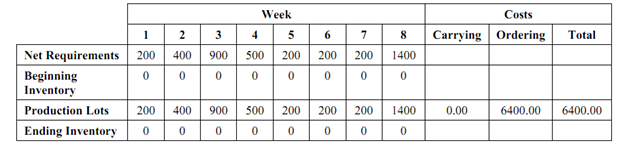
 (a)       Develop the total carrying costs over the eight week schedule for the lot-for-lot method. Lot-For-Lot (LFL) production lots equal the net requirement in each period.
 

1051_Implementation of MRP1.png

Ordering costs = Numbers of orders × 800.00 = 8 × 800.00 = 6400.00

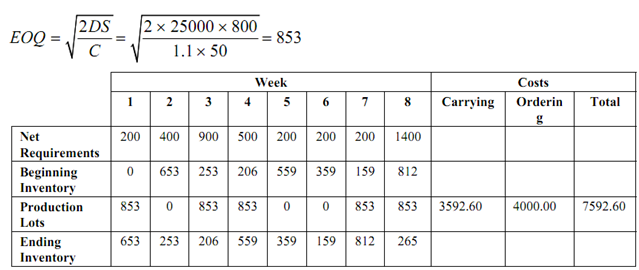
 (b)       Develop the overall carrying costs over the eight week schedule for the EOQ lot sizing method. EOQ production lots equal the computed EOQ. First, compute the EOQ :
447_Implementation of MRP2.png

Carrying costs = total of ending inventories × 1.10 = 3266 × 1.10 = 3592.60

Ordering costs = Number of orders × 800.00 = 5 × 800.00 = 4000.00

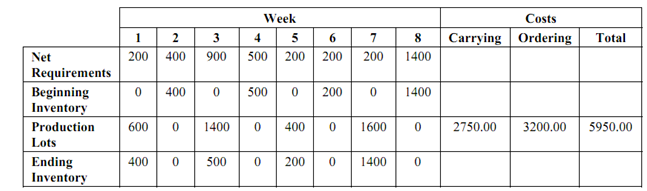
 (c)       Develop the overall carrying costs over the eight week schedule for the POQ lot sizing method. POQ production lots equal the net requirements for POQ computed periods.

First, compute the POQ:

POQ = Number of weeks per year/ Number of order per year

=          50/(D/ EOQ) = 50/(25000/853)

= 1.706 or 2 weeks per order
 

2068_Implementation of MRP3.png

Carrying costs= sum of ending inventories × 1.10 = 2500 × 1.10 = 2750.00

Ordering costs = Number of orders × 800.00 = 4 × 800.00 = 3200.00

Among the lot sizing methods considered for this data, the POQ method exhibits the least carrying and ordering cost for the eight week net requirements schedule.

1. Where is MRP implemented?

2. Explain different lot sizing methods.


Related Discussions:- Implementation of material requirement planning

What is vibration?, Describe vibration, How to calculate vibration?

Describe vibration, How to calculate vibration?

Pulsed dc welding, Pulsed DC Welding Pulsed DC involves the repetitive ...

Pulsed DC Welding Pulsed DC involves the repetitive variation in arc current from a background (low) value to a peak value. Adjustments of the pulse current time, background cu

Prove the parallelogram law of forces - mechanics, Prove the parallelogram ...

Prove the parallelogram law of forces: Assume that the two forces P and Q act at a point ' O ' as shown in figure given below. The force P can be represented in magnitud

Stress-strain carves for ductile materials, Stress-strain carves for ductil...

Stress-strain carves for ductile materials: A material is said to be ductile in nature, if it elongates before fracture. One this type of material is mild steel. Shape of stre

Find out ratio of upper end area to lower end area of bar, Find out ratio o...

Find out ratio of  upper end area to lower end area  of bar of uniform strength Sol : The figure given to us shows a bar subjected to external tensile load P. If bar had be

Steam hot service insluation thicknesses, Q. Steam Hot Service Insluation T...

Q. Steam Hot Service Insluation Thicknesses? Steam Hot Service Insluation Thicknesses are specified based on the following design criteria: Average Annual Climatic Condi

Describe microscopic and macroscopic approaches, Distinguish between micros...

Distinguish between microscopic and macroscopic approaches. Describe thermodynamic system. Differentiate between closed system, open system and an isolated system.

Write Your Message!

Captcha
Free Assignment Quote

Assured A++ Grade

Get guaranteed satisfaction & time on delivery in every assignment order you paid with us! We ensure premium quality solution document along with free turntin report!

All rights reserved! Copyrights ©2019-2020 ExpertsMind IT Educational Pvt Ltd