Human evolution, Science

Assignment Help:

Human Evolution:

Charles Darwin in  the 'Origin of Species' gave a lilechanism for the evolution of  plants and animals in general, even  though he had speculated about the origin of man. Four years later, he published  the "Descent of Man",  in which he speculated that like other animals, man too had evolved form pre-existing  living forms. Darwin was greatly impressed by  the similarities in  the bodily structure of man and thegreat African apes, the Chimpanzee and the Gorilla.

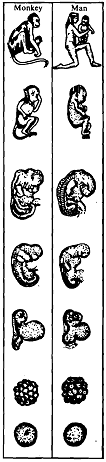
From this, he speculated on the location of man's origins. In his own words, "In each great region of  the world, the living mammals are closely related to the extinct species of  the same region.  It  is, therefore, probable that Africa was formerly inhabited by extinct apes, closely allied tothe gorilla and chimpanzee; and as these two species are now man's nearest allies, it is somewhat more than probable, that our early ancestors lived on the African  continent than elsewhere". Darwin had noted that embryos, i.e.  early unborn young ones, of  different organisms pass through very similar stages. However, small alterations in the timings of  events in early development might produce a substantial change in the mature organism; for example in many ways adult humans are like juvenile apes,  their small faces and globular cranium bones enclosing the brain  are indicative of  this.
 

953_Human Evolution.png

A  crucial step in human evolution, enlargement of  the brain, can be seen as a result of  the slowing down of  development  in the embryo of  an ape-like ancestor. Instead of stopping at birth, brain growth continues well  into childhood, eventually producing a much larger and more complicated piece of  mental machinery. 


Related Discussions:- Human evolution

Physico-chemical properties of niacin, Important physico-chemical propertie...

Important physico-chemical properties of niacin and niacinamide are as follows: a)  Niacin is a white crystalline solid. b) While niacin  is sparingly soluble in water, etha

Earth, Earth How do we describe the 'big ball' on which we live? Seen f...

Earth How do we describe the 'big ball' on which we live? Seen from space, it appears as a bluish-white sphere. Its wealth of plant and animal life, snow covered peaks, blue oc

Explain sympathetic - nerves system, Explain Sympathetic - Nerves System ...

Explain Sympathetic - Nerves System Sympathetic, as the word suggests, means to sympathize. The body sympathizes during fight, flight and fright reaction. For example, have you

How to prevent the erosion of topsoil, How to prevent the erosion of topsoi...

How to prevent the erosion of topsoil Use the trays constructed for the experience above. (a)  Fill the trays with loose soil and tilt everyone the similar amount. Make furr

Explain factors regulating blood pressure, Explain Factors Regulating Blood...

Explain Factors Regulating Blood Pressure Blood pressure regulating mechanisms may be classified into two categories: a)  Short term regulating mechanisms, which regulate an

Define primary transport, Define Primary Transport Primary transport em...

Define Primary Transport Primary transport employes energy directly, light or chemical energy is transformed to electrochemical energy as electrochemical potential of the subst

Explain processing of minor cereals, Processing of minor cereals Maize...

Processing of minor cereals Maize, jowar, bajra, ragi and other small millets are important minor cereals of our country. They are also termed as coarse grains. They are widel

Nutrients, which nutrient contains carbon, hydrogen, oxygen, nitrogen and s...

which nutrient contains carbon, hydrogen, oxygen, nitrogen and sometimes sulphur and phosphorus?

Explain vagus nerve - neural control of respiration, Explain Vagus Nerve - ...

Explain Vagus Nerve - Neural Control of Respiration The rhythm and depth of respiration are controlled by the reflexes from the vagus nerve. When the lungs are inflated, the

What is the earth made of, What is the earth made of? The overall compo...

What is the earth made of? The overall composition of the Earth, in terms of elemental composition is as follows:   Iron 34.6% Oxygen 29.5% Magnesium 12.7% Silic

Write Your Message!

Captcha
Free Assignment Quote

Assured A++ Grade

Get guaranteed satisfaction & time on delivery in every assignment order you paid with us! We ensure premium quality solution document along with free turntin report!

All rights reserved! Copyrights ©2019-2020 ExpertsMind IT Educational Pvt Ltd