How much to order, Managerial Accounting

Assignment Help:

How much to order

Supposing the estimated annual usage of a component by Machinery Ltd is 20,000 units.  Usage is even throughout the year and only one order per annum is placed with the supplier.  Because only one delivery is made, average stock will be high, i.e. 20,000/2 = 10,000 and consequently stockholding costs will be very high. On the other hand, the costs of ordering will be negligible. If two orders are placed there will be less in stock (i.e. average 5,000), which will reduce holding costs, but ordering costs will increase. Thus, the higher the number of orders placed, the lower are stockholding costs, but the higher are ordering costs.

Stockholding costs include interest on the capital invested in stocks, storage, insurance, rates, security, building maintenance, heating, etc. Ordering costs include buying-department staff costs, receiving and handling.

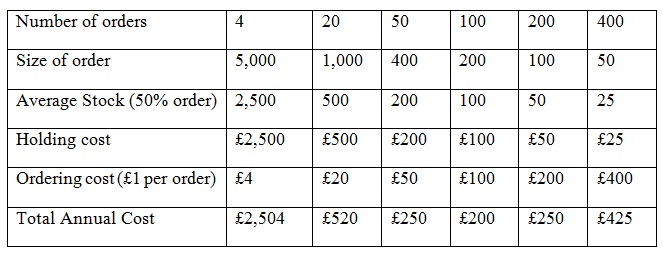
Assuming that the cost of each component is £10, that holding cost is 10% of stock value and the cost of placing an order is £1, the total annual cost of stockholding and ordering when different numbers of orders are placed, is as follows:
2292_table.jpg


1202_graph.jpg


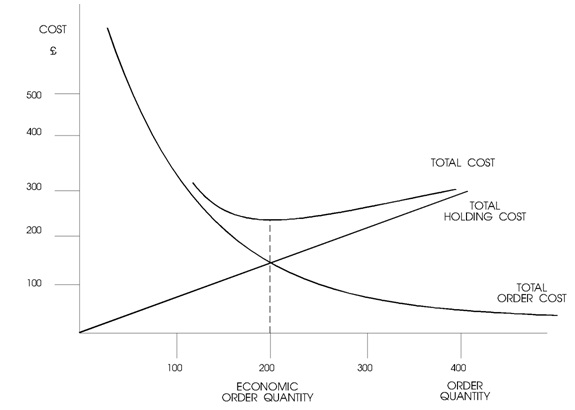
Figure: Economic Order Quantity

Placing 100 orders a year results in the lowest of ordering and holding cost of £200, therefore the economic order quantity is 200 units.

The same information is graphed in figure above, showing that the economic order quantity (EOQ) is the point where ordering and holding costs are equal, and total £200.


Related Discussions:- How much to order

Order acceptance or rejection, Excess machine hours 20,000. Received offers...

Excess machine hours 20,000. Received offers from two companies to buy 210,000 units of F at 0.60 and 300,000 units of D at 0.70. Estimated costs for the two products are;

Queuing theory, QUEUING THEORY When limited facilities fail/delays to s...

QUEUING THEORY When limited facilities fail/delays to satisfy demands made upon them, problems occur which generate queues or waiting lines. Illustrations are: •    Customers

Identify the management assertions, Identify the management assertions rela...

Identify the management assertions related to each of the fictitious supplier credits and unrecorded amounts in accounts payable using the facts presented

What is liquidity ratios, Liquidity ratios Liquidity refers to the abil...

Liquidity ratios Liquidity refers to the ability of concern to meet its current obligations as and when these become due. The short term obligations are met by realizing amount

What are the disadvantages of incremental budgeting, Disadvantages of incre...

Disadvantages of incremental budgeting a) Incremental budgeting suppose activities and method of working will continue in the same way b) No incentive for developing their d

Which of the following costs is an example of a cost, Which of the followin...

Which of the following costs is an example of a cost that remains the same in total as the number of units produced changes?

Monitor, Monitor Let's start by having you think about the controlling ...

Monitor Let's start by having you think about the controlling your car (aka "driving")! Your steering, acceleration, and braking are not the random things to be done; they are

Explain the investment versus speculation, Explain the Investment versus Sp...

Explain the Investment versus Speculation? In brief describes the following terms: a) Investment versus Speculation. b) Active and Passive Equity Management c) Systematic v

Capital budgeting, what is the computation procedure of accounting rate of ...

what is the computation procedure of accounting rate of return?

Write Your Message!

Captcha
Free Assignment Quote

Assured A++ Grade

Get guaranteed satisfaction & time on delivery in every assignment order you paid with us! We ensure premium quality solution document along with free turntin report!

All rights reserved! Copyrights ©2019-2020 ExpertsMind IT Educational Pvt Ltd