Graduated-payment mortgages (gpms), Financial Management

Assignment Help:

The payments on GPMs unlike the payments on traditional mortgages are not equal. The payments under GPMs start at a relatively low level and rise for a specified number of years and then become equal after the specified number of years. The level of steps of increase and the specified number of years after which the payments become equal depend upon the plan indicated in the mortgage agreement.

The terms of five popular plans are given in the table below:

Table 1: Graduated-Payment Mortgages

Plan

Term to Maturity
(in years)

Years that Payments Rise

Percentage Increase per year (%)

  I

         30

      5

           2.5

 II

         30

      5

           5.0

III

         30

      5

           7.5

IV

         30

     10

          2.0

 V

         30

     10

          3.0

The comparison between monthly payments under a GPM based on Plan III and those under a traditional mortgage for a loan of $100,000 at 10% interest is given below:

Table 2

Year(s)

Monthly Payment under GPM ($)

Monthly Payments under Traditional Mortgage ($)

        1

   667.04

          877.58

        2

   717.06

          877.58

        3

   770.84

          877.58

        4

   828.66

          877.58

        5

   890.80

          877.58

    6-30

   957.62

          877.58

GPMs are preferred by young first-home buyers whose current income is not sufficient to take on a large loan, but whose income is expected to increase rapidly in the near future.

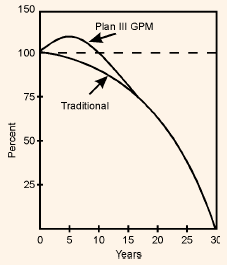
As GPMs have smaller initial payments than the traditional mortgages, they do not pay down their mortgage balances quickly. Another feature of GPMs is that the mortgage balance increases for a short period of time because smaller payments in the initial years do not even cover the interest and the shortfall is added back to the mortgage balance. However, with the increase in the monthly payments, mortgage balance gradually decreases and eventually reaches zero by the end of the term.

Figure 3: Comparison between Plan III GPM and a Traditional Mortgage              
1569_comparison of GPM and traditional mortgage.png

Figure shows the mortgage balance for a traditional and a plan III GPM. Under plan III GPM, mortgage balances increase for a particular period and then start declining.              


Related Discussions:- Graduated-payment mortgages (gpms)

Describe market value weights, Q. Describe Market Value Weights? Market...

Q. Describe Market Value Weights? Market Value Weights: - As per market worth scheme of weighting the weights to dissimilar sources of finance are assigned on the basis of thei

Marshall-edgeworth method, Marshall-Edgeworth Method Marshall-Edgeworth...

Marshall-Edgeworth Method Marshall-Edgeworth method uses both the current year as well as the base year prices and quantities. Marshall-Edgeworth Index can be computed using th

Asset-backed securities, Introduction When financial assets...

Introduction When financial assets or bonds are pooled together and offered to the investors for receiving the inflow of funds from these underlying

I need urgent help in Financial Managment, How to get cost differential whe...

How to get cost differential when 100% done by a single party only.

Analyse and interpret company financial statements, INSTRUCTIONS Downl...

INSTRUCTIONS Download the 2011 Annual Report for Marks and Spencer PLC, from the link provided on Study Space. Review the Annual Report, paying particular attention to the Fin

Explain what is comprehensive income, Q. Explain what is Comprehensive Inco...

Q. Explain what is Comprehensive Income? Comprehensive Income - Change in EQUITY of a business enterprise during a period from transactions and other circumstances and events f

Explain pro forma financial statements management goals, Explain how manage...

Explain how management goals are incorporated into pro forma financial statements. Management put a target goal and forecasters makes pro forma financial statements under the

Translation process among the monetary/nonmonetary method, Explain the dist...

Explain the distinction in the translation process among the monetary/nonmonetary method and the temporal method. Answer:  Within the monetary or nonmonetary method, every mone

Enumerate the internal development of any business, Enumerate the Internal ...

Enumerate the Internal development of any business or 'organic growth' Business grows using its own internal resources. - Reduces risk of the high cost of integrating cultur

Determine the amount of financing required - cost of capital, Determine the...

Determine the Amount of financing required   The last factor determining company's cost of funds is the amount of financing required, where cost of capital increases as the fin

Write Your Message!

Captcha
Free Assignment Quote

Assured A++ Grade

Get guaranteed satisfaction & time on delivery in every assignment order you paid with us! We ensure premium quality solution document along with free turntin report!

All rights reserved! Copyrights ©2019-2020 ExpertsMind IT Educational Pvt Ltd