Function of tcp - ip transport layer, Computer Networking

Assignment Help:

Q. Function of TCP/IP Transport Layer ?

TCP/IP Transport Layer

- Defines two standard transport protocols UDP and TCP

- TCP equipment a dependable data-stream protocol

  • Connection oriented

- UDP implements an undependable data-stream

  • Connectionless

- TCP offers reliable data transmission

- UDP is helpful in many applications

  • e.g. Where data requirements to be broadcasted or multicasted

- Primary difference is that UDP doesn't necessarily provide reliable data transmission

- Several programs will use a separate TCP connection as well as a UDP connection
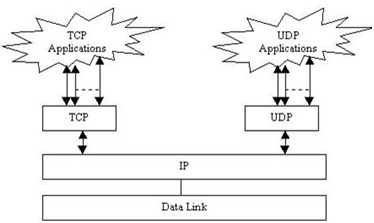
1031_Function of TCP - IP Transport Layer.png

- TCP is accountable for data recovery

  • By providing a series number with each packet that it sends
  • TCP needs acknowledgement (ACK) to ensure correct data is received

- Packet is able to be retransmitted if error detected

- Use of acknowledgement (ACK)
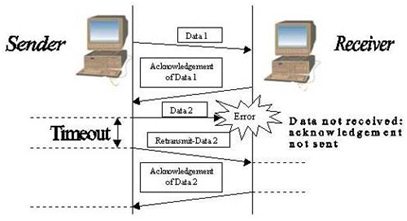
2217_Function of TCP - IP Transport Layer1.png

- Flow control with Window

  • by means of specifying an acceptable range of sequence numbers
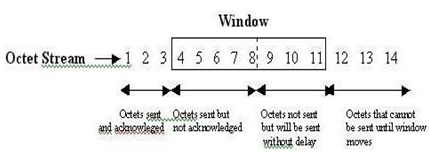
610_Function of TCP - IP Transport Layer2.png

- UDP and TCP introduce the concept of ports

- Common ports as well as the services that run on them:

 FTP 21 and 20

 telnet 23

 SMTP 25

 http 80

 POP3 110

- By specifying ports as well as including port numbers with TCP/UDP data multiplexing is achieved

- Multiplexing permits multiple network connections to take place simultaneously

- The port numbers together with the source and destination addresses for the data determine a socket


Related Discussions:- Function of tcp - ip transport layer

IPV6, is DVMRP multicast prtocol supports IPV6?

is DVMRP multicast prtocol supports IPV6?

What is a counter, What is a Counter A software code that indicates ...

What is a Counter A software code that indicates how many times a site has been visited. It gets automatically updated and is usually represented by a small rectangle with n

Tcp-ip and osi differences, Q. TCP-IP and OSI Differences - TCP/IP com...

Q. TCP-IP and OSI Differences - TCP/IP combines the Presentation and Application Layers - TCP/IP combines the OSI Data Link and Physical Layers into 1 Layer - TCP/IP app

Determine the term - backend lan, Determine the term - Backend LAN Back...

Determine the term - Backend LAN Backend networks are used to interconnect large systems like mainframes, supercomputers, and mass storage devices. The key needs here is for bu

Describe essential security services, Problem: (a) Application Layer pr...

Problem: (a) Application Layer protocols can be classified as connection-oriented or connectionless-oriented. i. What do you understand by the term protocol? ii. Give an e

C, #questionWrite a program to find the area under the curve y = f(x) betwe...

#questionWrite a program to find the area under the curve y = f(x) between x = a and x = b, integrate y = f(x) between the limits of a and b. The area under a curve between two poi

Describe smtp, a) Used for sending e-mail. b) Uses port 25.

a) Used for sending e-mail. b) Uses port 25.

What are the advantages of star topology, What are the advantages of Star T...

What are the advantages of Star Topology? The advantages of star topology are: a. Relatively easy to configure. b. Simple to troubleshoot c. Media faults are automatic

What is virtual lans, Q. What is Virtual LANs? Virtual LANs - LAN...

Q. What is Virtual LANs? Virtual LANs - LAN (Local area network) configured by software not by physical wiring Virtual LANs - Divides a LAN into logical, in

Write Your Message!

Captcha
Free Assignment Quote

Assured A++ Grade

Get guaranteed satisfaction & time on delivery in every assignment order you paid with us! We ensure premium quality solution document along with free turntin report!

All rights reserved! Copyrights ©2019-2020 ExpertsMind IT Educational Pvt Ltd