Find the pure-strategy nash equilibrium, Game Theory

Assignment Help:

Find the pure-strategy Nash equilibrium

Alice is on vacation in Wonderland and considers trying a special mushroom sold by the caterpillar. She cannot tell upfront if the mushroom is good or bad; she only discovers it later if it gives her a stomach ache. For the caterpillar, it costs more to sell good quality mushroom. The payoffs of Alice and the caterpillar are given in the table below:
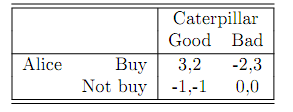
1253_Find the pure-strategy Nash equilibrium.png

(a) A pure strategy is a strategy that does not involve randomization. Find the pure-strategy Nash equilibrium/equilibria of this game.

(b) Alice likes Wonderland so she decides to stay there for 10 days: the above game is repeated 10 times. Can you find a trigger strategy that induces Buy/Good for all 10 periods? How about the first 9 days?

(c) Alice falls in love with Wonderland and decides to live there for the rest of her life. The above game is thus repeated infinitely. If the interest rate is zero, explain what trigger strategy will induce the cooperative Buy/Good equilibrium.

(d) Assume now that the interest rate is greater than zero, and the game is repeated infinitely. Find a range of r such that the cooperative equilibrium can be sustained.

(e) It is possible that Alice will have to leave Wonderland and return home eventually. More specifically, each period players think that there is a 30% chance that the game does not continue next period. Is the cooperative equilibrium still possible to maintain? If yes, for what values of the interest rate? If not, why not?


Related Discussions:- Find the pure-strategy nash equilibrium

Hicks, Winner of the Nobel Prize in 1972, Hicks is acknowledged mutually of...

Winner of the Nobel Prize in 1972, Hicks is acknowledged mutually of the leading economists normally equilibrium theory. he's credited with the introduction of the notion of elasti

Game playing in class-equilibrium payoffs are (4, Equilibrium payoffs are (...

Equilibrium payoffs are (4, 5). Player A’s equilibrium strategy is “S then S if n and then N if n again.” Player B’s equilibrium strategy is “n if S and then n if S again and then

Nature player , A participant in a very game who selects from among her met...

A participant in a very game who selects from among her methods randomly, primarily based on some predetermined chance distribution, instead of strategically, primarily based on pa

Green –beard strategy, 1  A, Explain how a person can be free to choose but...

1  A, Explain how a person can be free to choose but his or her choices are casually determined by past event 2  B , Draw the casual tree for newcomb's problem when Eve can't pe

Fighting for survival, Two animals are fighting over a prey. The prey is wo...

Two animals are fighting over a prey. The prey is worth v to each animal. The cost of fighting is c1 for the first animal (player 1) and c2 for the second animal (player 2). If the

Two player problem of points set up - game theory, a) Show that A c...

a) Show that A counting proof could be fun(?). But any old proof will do. (Note that the coefficients (1,2,1) in the above are just the elements of the second row of Pas

Cournot Game, I have a problem with an exercise about Cournot game. It is v...

I have a problem with an exercise about Cournot game. It is very complex and it is composed by different question and it is impossible for me to write the complete text. I need som

Player , Any participant in a very game who (i)  contains a nontrivial s...

Any participant in a very game who (i)  contains a nontrivial set of methods (more than one) and (ii) Selects among the methods primarily based on payoffs. If a player is non

Game :the tire story, GAME 2 The Tire Story Another game that we have ...

GAME 2 The Tire Story Another game that we have successfully played in the first lecture is based on the “We can’t take the exam; we had a flat tire”. Even if the students hav

Bayes, Eighteenth century British mathematician who recognized a method for...

Eighteenth century British mathematician who recognized a method for probabilistic mathematical inference. His Bayes Theorem, published posthumously, treats probability as a logic.

Write Your Message!

Captcha
Free Assignment Quote

Assured A++ Grade

Get guaranteed satisfaction & time on delivery in every assignment order you paid with us! We ensure premium quality solution document along with free turntin report!

All rights reserved! Copyrights ©2019-2020 ExpertsMind IT Educational Pvt Ltd