Find out function is increasing and decreasing, Mathematics

Assignment Help:

Find out where the following function is increasing & decreasing.

A (t ) = 27t 5 - 45t 4 -130t 3 + 150

Solution

As with the first problem first we need to take the derivative of the function.

A′ (t ) = 135t 4 -180t 3 - 390t 2  = 15t 2 (9t 2 -12t - 26)

Next, we have to determine where the function isn't changing.  It is at,

t = 0

1966_function is increasing.png

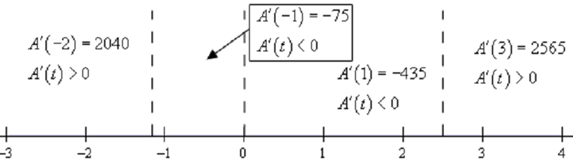
Thus, the function is not changing at three values of t.  At last, to find out where the function is increasing or decreasing we have to determine where the derivative is +ve or -ve.

Recall that if the derivative is +ve then the function have to be increasing & if the derivative is -ve then the function have to be decreasing. The given number line gives this information.
2423_function.png

Thus, from this number line we can illustrate which we have the given increasing & decreasing information.

Increasing : - ∞ < t < -1.159, 2.492 < t < ∞

Decreasing : -1.159 < t < 0, 0


Related Discussions:- Find out function is increasing and decreasing

Determine the length of the longer base, The longer base of a trapezoid is ...

The longer base of a trapezoid is 3 times the shorter base. The nonparallel sides are congruent. The nonparallel side is 5 cm more that the shorter base. The perimeter of the trape

Determine the second derivative of q (t ) = sec (5t ), Determine the secon...

Determine the second derivative for following functions.                             Q (t ) = sec (5t ) Solution : Following is the first derivative.              Q′ (t

Minimizes the sum of the two distance, The value of y that minimizes the su...

The value of y that minimizes the sum of the two distances from (3,5) to (1,y) and from (1,y) to (4,9) can be written as a/b where a and b are coprime positive integers. Find a+b.

We know this equation a°=1.prove this?, we know that    A^m/A^m=1         ...

we know that    A^m/A^m=1                    so A^(m-m)=1                    so A^0=1.....

Calculate values of kinetics , A reaction following first-order kinetics wa...

A reaction following first-order kinetics was studied by determining the reactant concentrations at equal time intervals. Each successive pair of concentrations, [A] o and [A] 1

Mechnics, i have many trouble in this subject

i have many trouble in this subject

Write Your Message!

Captcha
Free Assignment Quote

Assured A++ Grade

Get guaranteed satisfaction & time on delivery in every assignment order you paid with us! We ensure premium quality solution document along with free turntin report!

All rights reserved! Copyrights ©2019-2020 ExpertsMind IT Educational Pvt Ltd