Explain thevenin and norton equivalent circuits, Electrical Engineering

Assignment Help:

Q. Explain Thevenin and norton equivalent circuits?

For a linear portion of a circuit consisting of ideal sources and linear resistors, the volt-ampere (v-i) relationship at any two accessible terminals can be expressed by the linear equation

v = Ai + B

where A and B are two constants. The Thévenin equivalent circuit at any two terminals a and b (to replace the linear portion of the circuit) is given by

v = RThi + voc

where it can be seen that

RTh = v/i|voc = 0

and

voc = v|i=0

Thus, voc is known as the open-circuit voltage (or Thévenin voltage) with i = 0, and RTh is the Thévenin equivalent resistance (as seen from the terminals a-b) with voc = 0. Equation accounts for the ideal sources present in that linear portion of the circuit, as shown in Figure (a), where as Equation implies deactivating or zeroing all ideal sources (i.e., replacing voltage sources by short circuits and current sources by open circuits). Themodel with the voltage source voc in series with RTh is known as Thévenin equivalent circuit, as shown in Figure(b).

Equation may be rewritten as

i = v / A - B / A = v / RTh - voc / RTh = v / RTh - isc

which is represented by the Norton equivalent circuit with a current source isc in parallel with RTh, as shown in Figure. Notice that with v = 0, i = -isc. Also, isc = voc/RTh,or voc = iscRTh.
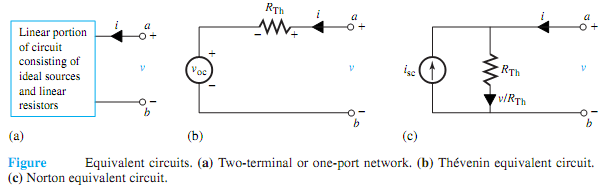
1763_Thevenin equivalent circuit.png


Related Discussions:- Explain thevenin and norton equivalent circuits

Difference between and and test instructions, Mention how do the AND & T...

Mention how do the AND & TEST instructions differ in their functionality AND: Changes the destination operand while performs the AND operation and. TEST: This ins

Synchronous and asynchronous serial communication, Differentiate between sy...

Differentiate between synchronous and asynchronous types of serial communication.   Serial data communication uses two fundamental types as, synchronous and asynchronous. With

Working of field-effect transistors, Q. Working of Field-effect transistors...

Q. Working of Field-effect transistors? Field-effect transistors (FETs) may be classified as JFETs (junction field-effect transistors), depletion MOSFETs (metal-oxide-semicondu

Develop a block diagram of an asynchronous decade counter, Q. Counting to m...

Q. Counting to moduli other than 2 is a frequent requirement, the most common being to count through the binary-coded decimal (BCD) 8421 sequence. All that is required is a four-st

Switching characteristics, Switching Characteristics The switching  cha...

Switching Characteristics The switching  characteristic  of an IGBT  during  turn on and turn off time all  shown  in the sum of delay time  and rise time gives  the total  tur

Find the line current and voltage across the load, Q. (a) A balanced wye-co...

Q. (a) A balanced wye-connected load with per-phase impedance of 20 + j10 is connected to a balanced 415-V, three-phase supply through three conductors, each of which has a series

What do you mean by insurance, Q. What do you mean by Insurance? This i...

Q. What do you mean by Insurance? This is done by creating a common fund out of the contribution (known as premium) from several persons who are equally exposed to the same los

What is the pipelining, A method used in advanced microprocessors where the...

A method used in advanced microprocessors where the microprocessor begins implementing a second instruction before the first has been done. That is, various instructions are in the

Explain digital control systems, Q. Explain Digital control systems? Si...

Q. Explain Digital control systems? Significant progress has been made in recent years in discrete-data and digital control systems because of the advancesmade in digital compu

Write Your Message!

Captcha
Free Assignment Quote

Assured A++ Grade

Get guaranteed satisfaction & time on delivery in every assignment order you paid with us! We ensure premium quality solution document along with free turntin report!

All rights reserved! Copyrights ©2019-2020 ExpertsMind IT Educational Pvt Ltd