Explain the energy, Physics

Assignment Help:

Explain the Energy

Again, we have all heard about energy. When the alarm clock rings in the morning we roll over and say, “I do not want to get up, I have no energy this morning.” In science, energy is the ability to do work and there are different kinds. Potential energy is energy that is stored and waiting to be used and kinetic energy is energy in movement.
5_enrgy.png

Now we’re going to assume something that is not true to make the problems simpler. We’re going to ignore friction. “How can you do that,” you say? There is always some friction in life and especially in physics. Well, physics is not just what happens in real life but also a set of rules to figure out how the world works. Basically, we can choose to leave out friction to just look at how other things effect  what happens.

Ignoring friction, if you do work on an object, you add to its energy a number of joules equal to the work you just did. Such as, if you throw a ball, the work you do with your arm - the force acting through a distance to speed up the ball - is changed into motion of the ball. So, your arm’s work is converted into kinetic energy of the ball.

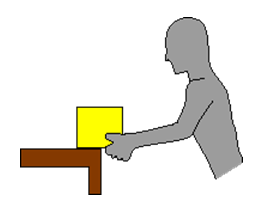
If you lift a box to a tabletop, you do work - pull up on the box to move it up to table height - and give the box more potential energy. Where is the potential energy? Consider this, would it hurt if I set the box on your toe? Would it hurt more if I dropped the box from table height onto your toe? Of course it would. If it can hurt your toe more, it has more “potential to hurt” or more potential energy. If it stays on the table, the energy stays potential, stored ready to be used, until I push it off the table. If I threw it down from table height, it could hurt even worse. Now, it has the potential energy from its height, plus kinetic energy from my throwing it - more energy, even more “ouch”.

Energy due to the height of an object above the Earth’s surface is called gravitational potential energy. There are other ways to store energy too, chemically, electrically, or with a spring.


Related Discussions:- Explain the energy

Total internal reflection, Total Internal Reflection: When a ray of li...

Total Internal Reflection: When a ray of light passes from denser medium to rare medium and angle of incidence is greater than the critical angle. The incident ray reflects ba

Explain squirrel- cage rotor, Explain Squirrel- cage rotor Squirrel- ca...

Explain Squirrel- cage rotor Squirrel- cage rotor having of a slotted laminated core of sheet-steel. The slots of the rotor are not always parallel to the slots on the stator,

Applications of newton''s laws - ii, APPLICATIONS OF NEWTON'S LAWS - II ...

APPLICATIONS OF NEWTON'S LAWS - II 1.  As the body moves through the body it displaces the fluid. It has to exert a force on the fluid to push it out of the path. By the Newto

How many joules of heat are radiated in 10 seconds, The potential differenc...

The potential difference across a 4 ohm resistor is 20 volts.  Suppose that all of the energy dissipated by this resistor is in the form of heat, how many joules of heat are ra

Define wave front, A wave front is a line or surface on which the disturban...

A wave front is a line or surface on which the disturbance has the similar phase at every position. If the source is periodic, it generates a succession of ray front, each of the s

Acsr (aluminium conductor steel reinforced), ACSR (Aluminium Conductor Stee...

ACSR (Aluminium Conductor Steel Reinforced): Owing to the low tensile strength of aluminium, aluminium conductors produce greater sag which prohibits their use for longer spans

Dual nature of light, Dual Nature of Light: As light is accepted as a f...

Dual Nature of Light: As light is accepted as a form of waves as well as packets of photon. This nature of light is known as dual nature of light.

OPTICS, How do I make a terrestrial telescope?

How do I make a terrestrial telescope?

Evaluate the final temperature, One mole of an ideal gas at 0°C is compress...

One mole of an ideal gas at 0°C is compressed adiabatically reversibly to a pressure of 20 times its initial pressure. Evaluate the final temperature.(γ=1.4)

Write Your Message!

Captcha
Free Assignment Quote

Assured A++ Grade

Get guaranteed satisfaction & time on delivery in every assignment order you paid with us! We ensure premium quality solution document along with free turntin report!

All rights reserved! Copyrights ©2019-2020 ExpertsMind IT Educational Pvt Ltd