Explain the different types of multivibrators, Electrical Engineering

Assignment Help:

Explain the different types of multivibrators ?

Multivibrator is basically  a two-stage amplifier with output of one supplied back to the input of the other .
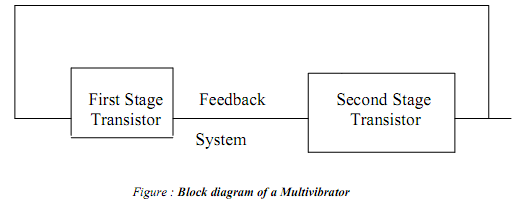
852_Explain the different types of multivibrators.png

Multivibrator is a switching circuit and may be defined as an electronic circuit that generates non-sinusoidal waves, such as rectangular waves, saw tooth waves, square waves etc. Multivibrators are capable of storing binary numbers, counting pulses, synchronsing arithmetic operations and performing other, essential functions in digital systems. In a multivibrator, each amplifier stage supplies feedback to the other stage in such a way that one transistor is driven to saturation and the other to cut-off or vice-versa. This is termed as the state of the multivibrator. The condition in which the multivibrator may remain indefinitely until the circuit is triggered by some external signal is termed as the stable state.

There are only two possible states of a multivibrator are as follows:

  First state: Transistor T1 'on' and transistor T2 'off'

  Second state: Transistor T1 'off' and transistor T2 'on '

Depending upon the type of coupling network employed, the multivibrators are classified into the following three categories.

1. Astable or free-running multivibrator.

2. Monostable or single-shot multivibrator.

3. Bistable or flip-flop multivibrator.

The first one is the non-driven type whereas the other two are the driven type (also called triggered oscillators).

Multivibrators are used for various purposes such as generation of non-sinusoidal waveforms ( square, rectangular, sawtooth etc.) and pulses occurring  periodically, frequency division, synchronized generation of pulses and extended waveforms, generation of time delays, storage of binary bit of information etc.


Related Discussions:- Explain the different types of multivibrators

Find a local s-matrix for each triangle, Figure show two first-order triang...

Figure show two first-order triangular finite elements used to solve the Laplace equation for electrostatic potential. Find a local S -matrix for each triangle, and a global S -m

Engineering drawing, connect two given points A and B by a parabolic curve ...

connect two given points A and B by a parabolic curve when OA=60mm,OB=80mm and angle AOB=110 degree

Sub subtract instruction, SUB Subtract Instruction This  instruction  i...

SUB Subtract Instruction This  instruction  is used to  subtract the contents of any  register  or memory location from  the contents of  accumulator. There are two  formats as

Which metal has material with lowest resistivity, The material with lowest ...

The material with lowest resistivity is (A) Constantan.         (B) Silver. (C) manganin.            (D) nichrome. Ans: The material with lowest resist

Rar rotate accumulator right through carry instruction , RAR  Rotate Accum...

RAR  Rotate Accumulator Right Through Carry Instruction This instruction rotates the contents  of the  accumulator  towards right by  one bit. The D 7   bit moves to D 6 posi

Define permanent magnet, Define permanent magnet A permanent magnet is ...

Define permanent magnet A permanent magnet is a piece of ferromagnetic material (like as iron, nickel or cobalt) which has properties of attracting several pieces of these mater

Discuss the need of peripheral component interconnect bus, Discuss the need...

Discuss the need of PCI bus. Peripheral Component Interconnect (PCI): It was developed by Intel and introduced in 1993 year. This is geared particularly to fifth- and sixth-

Describe the function of material handling system, a) Diagram FMS layout co...

a) Diagram FMS layout configurations with labeling. b) what are the basic components of FMS?Discuss in briefly. c) Describe the function of material handling system.

For an n-channel jfet find voltage, Q. For an n-channel JFET with V A = 35...

Q. For an n-channel JFET with V A = 350 V, I DSS = 10 mA, and V P = 3V, find V DS that will cause i D = 11 mA when v GS = 0.

Explain a common emitter configuration without a feedback, Q. Explain a com...

Q. Explain a common emitter configuration without a feedback. A simple common emitter transistor amplifier--having no negative feedback--is not an ideal amplifier. This is beca

Write Your Message!

Captcha
Free Assignment Quote

Assured A++ Grade

Get guaranteed satisfaction & time on delivery in every assignment order you paid with us! We ensure premium quality solution document along with free turntin report!

All rights reserved! Copyrights ©2019-2020 ExpertsMind IT Educational Pvt Ltd