Explain Telephone hand set and it's working.
A standard telephone set is consisted of a transmitter, electrical network and a receiver for equalization, connected circuitry to control side tone levels and for regulating signal power, and required signalling circuitry.
In essence, a telephone set is an apparatus which creates an exact similarity of sound waves along with an electric current. Figure demonstrates the functional block diagram of a telephone set. The necessary elements of a telephone set are the ringer circuit, equalizer circuit, on/off hook circuit, hybrid circuit, microphone, speaker and a dialing circuit.
Ringer Circuit: The reason of the ringer is to alert the destination party of incoming calls. The audible tone by the ringer should be load adequate to be heard from a reasonable distance and offensive sufficient to make a person need to answer the telephone immediately possible. In modem telephones, the bell has been placed along with an electronic oscillator associated to the speaker.
On/off hook circuit: The on/off hook circuit (sometimes termed as a switch hook) is nothing more than an easy single-throw, double-pole (STDP) switch placed across the tip and ring. The switch is mechanically linked to the telephone handset in order that when the telephone is idle or on hook, the switch is open. While the telephone is in use or off hook, the switch is closed completing and electrical path by the microphone in between the tip and ring of the local loop.
Equalizer circuit: Equalizers are combination of passive elements (capacitors, resistors etc.) which are used to regulate the frequency and amplitude response of the voice signals.
Speaker: The speaker is the receiver, in essence for the telephone. The speaker changes electrical signals received by the local loop to acoustical signals (as sound waves) which can be heard and understood by human being. The speaker is connecting to the local loop by the hybrid network. The speaker is classically enclosed in the handset of the telephone with the microphone.
Microphone: For all practical reasons, the microphone is the transmitter for the telephone. The microphone changes acoustical signals in the form of sound pressure waves by the caller to electrical signals which are transmitted in telephone net-work by the hybrid network. The microphone and the speaker both are transducers, as they convert one form of energy in other form of energy. A microphone changes acoustical energy first to mechanical energy and after that to electrical energy.
Hybrid network: The hybrid network (sometimes termed as a duplex coil or hybrid coil) in a telephone set is a particular balanced transformer used to convert a two-wire circuit as the local loop into a four wire circuit as the telephone set and the vice-versa, therefore enabling full duplex operation over a two wire circuit. Fundamentally, the hybrid network separates the transmitted signals by the received signals. Outgoing voice signals are classically in the 1-V to 2-V range, whereas incoming voice signals are normally half that value. The other function of the hybrid network is to permit a small portion of the transmit signal to be returned to the receiver into the form of a sidetone. In adequate sidetone causes the speaker to increase his voice, making the telephone conversation appear unnatural. Excessively sidetone causes the speaker to talk too softly, so reducing the volume which the listener receives.
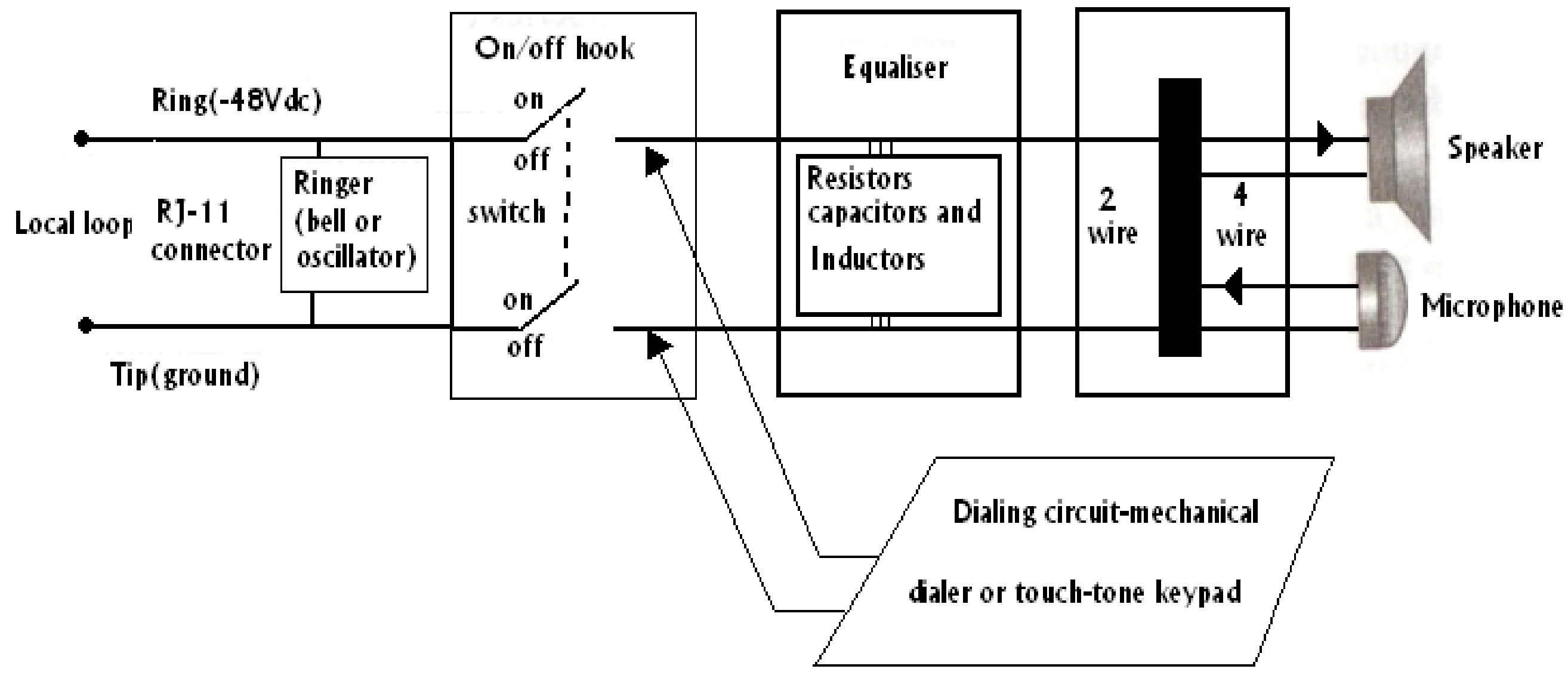
FIG - Functional Block Diagram of a Standard Telephone Set.
Dialing Circuit: This circuit enables the subscriber to output signals showing digits, and it enables the caller to enter the destination telephone number. This circuit could be a rotary dialer that is nothing more than a switch connected with a mechanical rotating mechanism that controls the number and interval of the on/off condition of a switch. Though, more than likely, the dialing circuit is either a Touch-Tone keypad or an electronic dial-pulsing circuit that sends various combinations of tones representing the termed as digits