Explain process scheduling in time sharing, Operating System

Assignment Help:

Explain process scheduling in time sharing

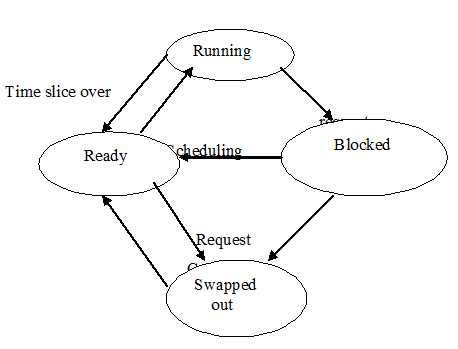
The relevant features of time sharing are:

1.      Process priorities do not depend on the nature of the processes

2.      Processes are scheduled in  the Round Robin manner

3.      A running process is pre-empt when its time slice elapses

4.      Processes perhaps swapped out of memory
 

927_process scheduling in time sharing.png


A repercussion of the round robin scheduling is that the priority of a process changes dynamically during its life time. It is the uppermost priority process when it is scheduled. It becomes the lowest priority process while it finishes its time slice or when it is blocked because of an IO request. Its efficient priority increases with time as it waits for the CPU

The action of the time sharing scheduler perhaps summarized as follows:

1.      The scheduler maintains 2 different PCB lists- one for ready processes and another for blocked and swapped out processes

2.      The PCB list for ready processes is prepared as a queue

3.      The PCB of a newly created process is able to be added to the end of the ready queue

4.      The PCB of a terminating process is able to be simply removed from the system

5.      The scheduler always selects the PCB on the head of the ready queue

6.      When a running process complete its time slice or makes an IO request its PCB is removed from the ready queue to the blocked/swapped-out list

7.      When the IO operation anticipated by a process finishes its PCB is moved from the blocked/swapped out list to the end of the ready queue


Related Discussions:- Explain process scheduling in time sharing

Explain the file-system manipulation, Q. Explain the File-system manipulati...

Q. Explain the File-system manipulation? File-system manipulation there is several details in file allocation, creation, deletion and naming that users should not have to perfo

Explain the communications of request or response interface, Explain the Co...

Explain the Communications of Request or Response Interface The inter-application communication must provide four specific interface to the CSInterface() components. A client m

Explain swapping, Explain Swapping Swapping is a method of temporarily ...

Explain Swapping Swapping is a method of temporarily removing inactive programs from the memory of computer system.

Can indefinite blocking take place, Consider the subsequent resource-alloca...

Consider the subsequent resource-allocation policy. Requests as well as releases for resources are allowed at any time. If a request for resources can't be satisfied because the re

What is process migration, Question: (a) Describe blocking and non-bloc...

Question: (a) Describe blocking and non-blocking types of inter-process communication. What is easier to implement and why? Discuss their relative advantages and disadvantage

Explain the various file types, Explain the various file types A common...

Explain the various file types A common technique for executing file types is to contain the type as part of the file name. The name is split into two parts - a name and an ext

Memory management, with aid of diagram describe 2 types of fixed partition ...

with aid of diagram describe 2 types of fixed partition allocation used in operating system

Write Your Message!

Captcha
Free Assignment Quote

Assured A++ Grade

Get guaranteed satisfaction & time on delivery in every assignment order you paid with us! We ensure premium quality solution document along with free turntin report!

All rights reserved! Copyrights ©2019-2020 ExpertsMind IT Educational Pvt Ltd