Explain by using a circuit diagram a darlington pair, Electrical Engineering

Assignment Help:

Q. Explain by using a circuit diagram, a ‘Darlington Pair'. Mention its advantages?

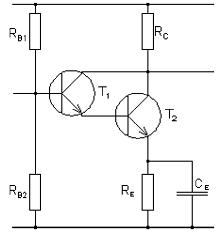
THE DARLINGTON PAIR : This is a very special way of direct coupling of two transistors. The two are connected with their collectors to the same point. The emitter of the first transistor is connected directly to the base of the next.
1771_Explain by using a circuit diagram a darlington pair4.png

A common emitter amplifier with Darlington. The two transistors are interconnected with their collectors, while the emitter of the first transistor feeds into the base of the second. An emitter resistor (RE1) is sometimes used for the first transistor to achieve faster switching.
 

351_Explain by using a circuit diagram a Darlington Pair1.png


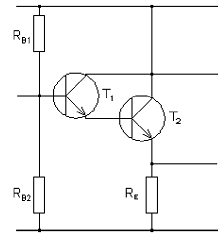
Common collector amplifier with Darlington. With this amplifier extremely high input resistances and extremely low output resistances can be achieved.


The advantage of the Darlington is the VERY HIGH CURRENT GAIN, which is the product of the current gains of the individual transistors. For ? values up to 20 000 can be achieved.

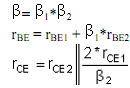
The Darlington has three terminals, like a normal transistor. In fact it can be considered as ONE transistor. The characteristics or this Darlington transistor can then be expressed in terms of the characteristics of the individual transistors:
 

1129_Explain by using a circuit diagram a Darlington Pair2.png


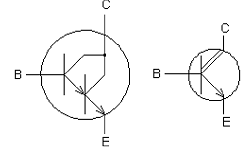
Darlington transistors are available in normal transistor housings, e.g. BC517 or BD675.
2419_Explain by using a circuit diagram a Darlington Pair3.png


A Darlington pair in one housing. As for normal transistors, the terminals are called collector, base and emitter.

Different circuit symbols are used for Darlington transistors. A transistor amplifier stage using a Darlington pair is normally considered as ONE amplifier stage, although two transistors are used.


Related Discussions:- Explain by using a circuit diagram a darlington pair

Transformers, A 15kVA has a turns ratio 1:10. If the voltage applied is 13....

A 15kVA has a turns ratio 1:10. If the voltage applied is 13.8kV and the applied load is 20+j6. Find the current in the secondary winding and the active and reactive power consumed

Gis based mapping of electrical network, GIS Based Mapping of Electrical Ne...

GIS Based Mapping of Electrical Network: You have learnt in which the Geographic Information System is a system of mapping of the complete electrical network. The question we

Addressing model , Addressing Model As we have learned  already  that ...

Addressing Model As we have learned  already  that each instruction has two  parts  one is  op code and another  is operand. Op code  specified  the type  of operations to be

Characteristics of transformer, Q. Characteristics of Transformer? The ...

Q. Characteristics of Transformer? The characteristics of most interest to power engineers are voltage regulation and ef?ciency. The voltage regulation of a transformer is a me

Calculate the new rotor current frequency, Induction motors are often brake...

Induction motors are often braked rapidly by a technique known as plugging, which is the reversal of the phase sequence of the voltage supplying the motor. Assume that a motor with

OC AND SC TEST OF AN ALTERNATOR, WRITE THE PROCEDURE CONDUCT OC AND SC TEST...

WRITE THE PROCEDURE CONDUCT OC AND SC TEST OF AN ALTERNATOR TO FIND SYNCHRONOUS IMPEDENCE

Obtain the node voltages and current through each element, Q. For the circu...

Q. For the circuit shown in Figure, develop and execute a PSpice program to obtain the node voltages and the current through each element.

Electromagnetic torque, The torque produced by each conductor in the field ...

The torque produced by each conductor in the field will be:  where A is the area of the armature winding in the magnetic field, Ia is the current in armature winding, and B

RLC, a 49pf cap,a 50 uH inductor, and a 100 ohms resister are in parallel: ...

a 49pf cap,a 50 uH inductor, and a 100 ohms resister are in parallel: what is the resonance freq? And what is the complex impedance vector at 100MHZ?

Write Your Message!

Captcha
Free Assignment Quote

Assured A++ Grade

Get guaranteed satisfaction & time on delivery in every assignment order you paid with us! We ensure premium quality solution document along with free turntin report!

All rights reserved! Copyrights ©2019-2020 ExpertsMind IT Educational Pvt Ltd