Explain about roasting process, Chemistry

Assignment Help:

Q. Explain about Roasting process?

Roasting is the method of heating ores in the presence of excess air and involves oxidation. It is mainly applied to sulphide ores, which are converted lo oxides or sulphates. Various impurities like sulphides of antimony and arsenic also get oxidised' and volatilised. For example,

4FeS2+ 11O2--------------> 2Fe2SO3+ 8SO2

ZnS + 2O2------------------> ZnSO4

2ZnS + 3O2-------------------> 2ZnO+ 2SO2

2As2S3+ 9O2--------------> 2As2O3+ 6 So2

When cuprous sulphide is roasted in a partial supply of air, it is partially oxidised to Cu20,

Which is then  reduced to copper by the residual cuprous sulphide:

2CuS2+ 3O2-------------> 2Cu2O + 2SO2

Cu2+ 2Cu2O-----------> 6CU + SO2

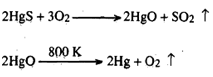
Sometimes, the oxides formed throughout roasting are unstable and decompose into elements at a moderately high temperature. For Illustration, in the roasting of cinnabar, the red sulphide ore of mercury, the oxide formed decomposes to provide the metal:
948_Explain about Roasting process.png


Related Discussions:- Explain about roasting process

Explain the process of grading and sieving, Explain the process of Grading ...

Explain the process of Grading and Sieving Grading: Grading consists of separating the sound kernels from chaff and impurities,and may be achieved by sieving or winnowing.

Ether., how yield of ether is highest when the halide ion is displased from...

how yield of ether is highest when the halide ion is displased from a primary rather than secondary or tertiary halide?

Molecular geometries, Use the VSEPR model to predict approximate molecular ...

Use the VSEPR model to predict approximate molecular geometries and electron-domain for the following species. (a) XeF 2 , (b) NH3Cl + , (c) BrO2 -

Six protons are found in the nucleus of, Six protons are found in the nucle...

Six protons are found in the nucleus of : (1) Boron              (2) Lithium     (3) Carbon  (4 )Helium Ans: Carbon

Beryllium, Anomalous behaviour of Beryllium

Anomalous behaviour of Beryllium

Electrogravimetry, give instrumentation of electrogravimetry

give instrumentation of electrogravimetry

The following compounds is ionic, Which of the following compounds is ionic...

Which of the following compounds is ionic: (1)  Kl        (2) CH 4                                    (3) Diamond           (4) H 2 Ans:   Kl

Salt analysis, Why NH4Cl and NH4OH are added to the test solution?

Why NH4Cl and NH4OH are added to the test solution?

Biochemisty, High energy bond in the intermediary metabolism

High energy bond in the intermediary metabolism

Write Your Message!

Captcha
Free Assignment Quote

Assured A++ Grade

Get guaranteed satisfaction & time on delivery in every assignment order you paid with us! We ensure premium quality solution document along with free turntin report!

All rights reserved! Copyrights ©2019-2020 ExpertsMind IT Educational Pvt Ltd