Example on indifference curves and budget lines, Microeconomics

Assignment Help:

Since 1990, real income has increased rapidly, yet the average number of children per family has decline." Three possible explanations for this process are given below. Explain each of them using indifference curves and budget lines showing the tradeoffs between the composite commodity (CC) and number of children. Also give a verbal explanation.

 a. Children are an inferior good; parents demand, as income rises fewer children.

ANSWER:  As given below, as income rises, the budget line gear up and the new optimal choice happens at the point of tangency between the highest indifference curve and new budget line. Since children are an inferior good, the quantity of children after the income increase will exceed the quantity of children before the income increase.

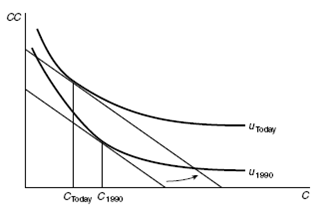
b. Children are basic goods but they have become more expensive to raise.

ANSWER: As explained below, an increase in the cost of raising children can pivot the budget line so that fewer children will be afforded if the entire income is used on children. The substitution effect may cause fewer children to be raised. The income effect can work in the same direction - a lower real income because of the increase of the cost of raising children will cause fewer children to be raised.
784_Example on indifference curves and budget lines.png

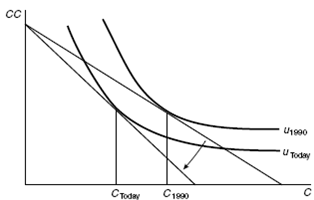
c. Children are not more expensive; the tastes of parents have modified, such that children are less preferred now than they were in 1990 ".

ANSWER: As explained below, a modification in tastes will modify the position and shape of the indifference curves - indifference curve will become flatter for each level of C. Thus, for a given budget line, fewer children will be raised.
1527_Example on indifference curves and budget lines1.png


Related Discussions:- Example on indifference curves and budget lines

Time serie, uses of time series in indian economy

uses of time series in indian economy

2nd year chapter 3, why s-block elements are powerful reducing agent?

why s-block elements are powerful reducing agent?

The hypothesis of inflation-unemployment trade-off, The Hypothesis of Infla...

The Hypothesis of Inflation-Unemployment Trade-off : This hypothesis about formation of expectations is therefore known as the hypothesis of adaptive expectations. The hypothes

Inflation-unemployment trade-off under rational expectations, Inflation-Une...

Inflation-Unemployment Trade-off under Rational Expectations : Robert Lucas (1972) pointed out another implication of the above hypothesis of adaptive expectations. Suppose in

Cost in the short run, Cost in the Short Run Marginal Cost (or MC) is t...

Cost in the Short Run Marginal Cost (or MC) is the cost of expanding output by one unit.  As fixed costs have no impact on marginal cost, it can be given as: Average Total

#question.Question: Answer all parts (a, Consider the following insurance m...

Consider the following insurance market. There are two states of the world, B and G, and two types of consumers, H and L, who have probabilities pH =0.5 and pL =0.25 (high and low

Which of the following statements is true?, Nonmetals tend to gain electron...

Nonmetals tend to gain electrons. A-Metals tend to lose electrons. B-Atoms have the natural tendency to C-fill their outermost shells. All of the above. D-

Monopoly market, 9. The average supernormal profit for the firm is

9. The average supernormal profit for the firm is

Write Your Message!

Captcha
Free Assignment Quote

Assured A++ Grade

Get guaranteed satisfaction & time on delivery in every assignment order you paid with us! We ensure premium quality solution document along with free turntin report!

All rights reserved! Copyrights ©2019-2020 ExpertsMind IT Educational Pvt Ltd