Example of implicit differentiation, Mathematics

Assignment Help:

Example of Implicit differentiation

So, now it's time to do our first problem where implicit differentiation is required, unlike the first example where we could actually avoid implicit differentiation by solving for y.

Example   Determine y′ for the following function.

                                                   x2 + y 2  = 9

Solution

Now, it is just a circle and we can solve out for y which would give,
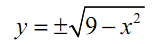
1797_implicite derivation.png

Prior to starting this problem we stated that we must do implicit differentiation here since we couldn't just solve out for y and still that's what we just did.  Thus, why can't we utilize "normal" differentiation here? The problem is the " ±".  With this in the "solution" for y we illustrates that y is actually two different functions. Which should we use?  Should we utilize both? We just want a single function for the derivative and at best we contain two functions here.

Thus, in this example really we are going to have to do implicit differentiation thus we can ignore this. In this instance we'll do the similar thing we did in the first example & remind ourselves that y is actually a function of x and write y as y (x) .  Once we've done it all we have to do is differentiate each term w.r.t x.

                                           dx2 [y ( x )]2  / dx = d (9)/dx

As with the first example the right side is simple.  The left side is also pretty simple as all we have to do is take the derivative of each of term and note  as well that the second term will be same the part (a) of the second example.  All we have to do for the second term is utilizes the chain rule.

After taking the derivative we contain,

                           2 x + 2 [y ( x ) ]1y′ ( x ) = 0

 At this instance we can drop the ( x ) part since it was only in the problem to help with the differentiation procedure. The last step is to just solve the resulting equation for y′ .

2x + 2 yy′ = 0

y′ = - x /y

We can't just plug in for y as we wouldn't know which of the two functions to utilization.  Most answers from implicit differentiation will include both x & y so don't get excited regarding that when it happens.


Related Discussions:- Example of implicit differentiation

Multiplication of two like terms with opposite signs, The product of -7ab a...

The product of -7ab and +3ab is (-7 x 3) a 2  b 2  = -21a 2  b 2 . In other words, a term with minus sign when multiplied with a term having a positive sign, gives a product having

Index numbers, advantages and disadvantages of index numbers

advantages and disadvantages of index numbers

Calculus 1, Suppose a Ferris wheel with radius of 12 meters is rotating at ...

Suppose a Ferris wheel with radius of 12 meters is rotating at a rate of 2 rotations per minute. a. How fast is a person rising when the person is 3 meters above the horizontal lin

Calculus, what is the derivatives of y=u/5+7 and u=5x-35 using the chain ru...

what is the derivatives of y=u/5+7 and u=5x-35 using the chain rule?

Solve the form ax2 - bx - c factoring polynomials, Solve the form ax 2 - b...

Solve the form ax 2 - bx - c factoring polynomials ? This tutorial will help you factor quadratics that look something like this: 2x 2 -3x - 14 (Leading coefficient is

Experience language pictures symbols-e - l - p - s , E - L - P - S : Has t...

E - L - P - S : Has the title of this section stumped you? Children, similarly, don't understand new symbols that are thrust upon them without giving them an adequate grounding. Y

Difererntial equation, Ask queFind the normalized differential equation whi...

Ask queFind the normalized differential equation which has {x, xex} as its fundamental setstion #Minimum 100 words accepted#

Describe the introduction to integers, Describe the Introduction to Integer...

Describe the Introduction to Integers ? Integers include the positive and negative whole numbers, such as -4, -3, -2, -1, 0, 1, 2, 3, 4, and so on. A negative number has a "

Show that positive integers is divisible by 6, Show that the product of 3 c...

Show that the product of 3 consecutive positive integers is divisible by 6. Ans: n,n+1,n+2 be three consecutive positive integers We know that n is of the form 3q, 3q +1

Write Your Message!

Captcha
Free Assignment Quote

Assured A++ Grade

Get guaranteed satisfaction & time on delivery in every assignment order you paid with us! We ensure premium quality solution document along with free turntin report!

All rights reserved! Copyrights ©2019-2020 ExpertsMind IT Educational Pvt Ltd