Evaluating the function at the point of limit, Mathematics

Assignment Help:

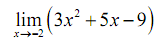
Calculate the value of the following limit.
2268_limit28.png

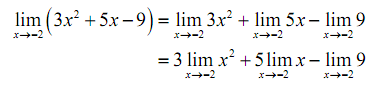
Solution: This first time through we will employ only the properties above to calculate the limit. Firstly we will employ property 2 to break up the limit in three separate limits. Then we will employ property 1 to bring the constants out of the first two limits.  Doing this gives us,
1893_limit29.png

Now we can use properties 7 through 9 to in fact compute the limit.

1036_limit30.png

                                            = 3( -2)2 + 5 ( -2) - 9

                                             =  -7

Now, let's note down that if we had defined

p ( x ) = 3x2 + 5x - 9

then the proceeding instance would have been,

239_limit31.png

= 3 (-2)2  + 5 ( -2) - 9

= -7

= p ( -2)

In other terms, in this case we illustrates that the limit is the similar value that we'd get just by evaluating the function at the point in question. It seems to violate one of the main concepts regarding limits that we've seen to this point.

In the earlier two sections we made a great deal regarding the fact that limits do not care about what is happening at the point in question. They simply care about what is happening around the point. Therefore how does the earlier example fit into this since it appears to violate this main idea regarding limits?

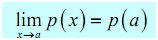
All polynomials are "nice enough" so that what is happening around the point is accurately the similar as what is happening at the point. It leads to the following fact.

Fact

If p(x) is polynomial then,
1921_limit32.png


Related Discussions:- Evaluating the function at the point of limit

Limit comparison test - sequences and series, Limit Comparison Test Ass...

Limit Comparison Test Assume that we have two series ∑a n and ∑b n with a n , b n   ≥ 0 for all n. Determine, If c is positive (i.e. c > 0 ) and is finite (i.e. c

Second order differential equations, In the earlier section we looked at fi...

In the earlier section we looked at first order differential equations. In this section we will move on to second order differential equations. Just as we did in the previous secti

Prove the parallelogram circumscribing a circle is rhombus, Prove that the ...

Prove that the parallelogram circumscribing a circle is rhombus. Ans   Given : ABCD is a parallelogram circumscribing a circle. To prove : - ABCD is a rhombus or AB

How many students are study physics alone, A class has 175 learners. The gi...

A class has 175 learners. The given table describes the number of learners studying one or more of the subsequent subjects in this case                 Subjects

Decimals, how to make 2.3 into a fraction?

how to make 2.3 into a fraction?

Triangles, The sides of a triangle are x^(2 )+x+1, 2x+1,x^2-1, prove that t...

The sides of a triangle are x^(2 )+x+1, 2x+1,x^2-1, prove that the largest angle is 120 degrees, and find range of x. Ans) The biggest side is x^(2) + x + 1 so findout the angl

Linear differential equations, The first particular case of first order dif...

The first particular case of first order differential equations which we will seem is the linear first order differential equation. In this section, unlike many of the first order

Properties of triangle, in a rhomus ABCD the circum radii of triangles ABD ...

in a rhomus ABCD the circum radii of triangles ABD and ACD are 12.5 cm and 25cm respetively then find the area of rhombus.

Probability., an insurance salesman sells policies to 5 men, all of identic...

an insurance salesman sells policies to 5 men, all of identical age in good health. the probability that a man of this particular age will be alive 30 years hence is 2/3.Find the p

Write Your Message!

Captcha
Free Assignment Quote

Assured A++ Grade

Get guaranteed satisfaction & time on delivery in every assignment order you paid with us! We ensure premium quality solution document along with free turntin report!

All rights reserved! Copyrights ©2019-2020 ExpertsMind IT Educational Pvt Ltd