Evaluate negative infinity, Mathematics

Assignment Help:

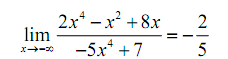
Evaluate both of the following limits.

137_limit.png

Solution : Firstly, the only difference among these two is that one is going to +ve infinity and the other is going to negative infinity.  Sometimes this small difference will influence then value of the limit and at other times it won't.

Let's begin with the first limit and since with our first set of examples it may be tempting to just "plug" in the infinity.  As both the numerator & denominator are polynomials we can use the above fact to find out the behavior of each.  Doing this gives,
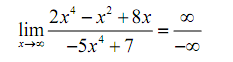
127_limit1.png

This is still another indeterminate form.  In this case we may be tempted to say that the limit is infinity (due to the infinity in the numerator), zero (due to the infinity in the denominator) or -1 (since something divided by itself is one). There are three separate arithmetic "rules" at work here & without work there is no way to know which "rule" will be accurate and to make matters worse it's possible that none of them might work and we might obtain a completely different answer, say -2/5 to pick a number totally at random.

Hence, when we have a polynomial divided by a polynomial we will proceed much as we did with only polynomials. First we identify the largest power of x in the denominator (and yes, we just look at the denominator for this) and then we factor this out of the numerator and denominator both.  Doing this for the first limit gives,
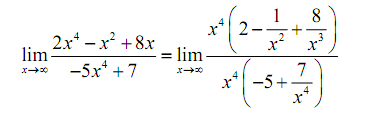
236_limit2.png

Once we've done it we can cancel the x- from the numerator and the denominator both and then utilizes the Fact 1 above to take the limit of all the remaining terms. it gives,
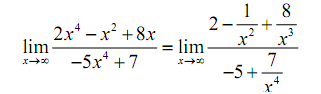
1961_limit3.png

=  2 + 0 + 0 / -5 + 0

= - 2 /5

1823_limit4.png

In this the indeterminate form was neither of the "obvious" option of infinity, zero, or -1 so be careful with make these kinds of supposition with this kind of indeterminate forms.

The second limit is done in alike fashion.  However, Notice that nowhere in the work for the first limit did we in fact use the fact that the limit was going to plus infinity.  In this it doesn't matter which infinity we are going towards we will obtain the similar value for the limit.


Related Discussions:- Evaluate negative infinity

Co-prime positive integers, A group of 5 people are going to meet weekly at...

A group of 5 people are going to meet weekly at the library for 4 weeks. Every week, two people are selected at random to speak. Every person may speak in multiple weeks, but no pa

Calculus, find or evaluate the integral integrate((e^2x + e^x + 1)/(e^x))dx...

find or evaluate the integral integrate((e^2x + e^x + 1)/(e^x))dx

Combining like terms, i don''t understand what my teacher when she talks ab...

i don''t understand what my teacher when she talks about when she talks about cosecutive integers etc... so can u help me???

Equation of a straight line, In a two dimensional case, the form of t...

In a two dimensional case, the form of the linear function can be obtained if we know the co-ordinates of two points on the straight line. Suppose  x' and  x"  are two

Fractions, how to add a fraction with an uncommon denomoninator

how to add a fraction with an uncommon denomoninator

Write prim's algorithm, Write Prim's Algorithm.   Ans: Prim's algorithm...

Write Prim's Algorithm.   Ans: Prim's algorithm to find out a minimum spanning tree from a weighted graph in step by step form is given below.  Let G = (V, E) be graph and S

What is limit x tends to 0 log(1+x)/x to the base a?, Here we will use the...

Here we will use the expansion method Firstly lim x-0 log a (1+x)/x firstly using log property we get: lim x-0 log a (1+x)-logx then we change the base of log i.e lim x-0 {l

Standard form of a complex number, Standard form of a complex number So...

Standard form of a complex number So, let's start out with some of the basic definitions & terminology for complex numbers. The standard form of a complex number is

Finding absolute extrema, Finding Absolute Extrema : Now it's time to see ...

Finding Absolute Extrema : Now it's time to see our first major application of derivatives.  Specified a continuous function, f(x), on an interval [a,b] we desire to find out the

Student, What is the slope and y intercept for (6,5) (-3,8)

What is the slope and y intercept for (6,5) (-3,8)

Write Your Message!

Captcha
Free Assignment Quote

Assured A++ Grade

Get guaranteed satisfaction & time on delivery in every assignment order you paid with us! We ensure premium quality solution document along with free turntin report!

All rights reserved! Copyrights ©2019-2020 ExpertsMind IT Educational Pvt Ltd