Evaluate limit, Mathematics

Assignment Help:

Evaluate the given limit.
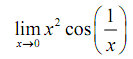
1478_limit55.png

Solution: In this question none of the earlier examples can help us. There's no factoring or simplifying to accomplish.  We can't rationalize & one-sided limits won't work. There's still a question as to whether this limit will present as we have division by zero within the cosine at x=0.

The firstly thing to notice is that we know the given fact about cosine.

                                                -1 ≤ cos ( x )≤ 1

Our function doesn't contain just an x in the cosine, however as long as we ignore x =0 we can say the similar thing for our cosine.

                                                       -1 ≤ cos ( 1/x ) ≤ 1

It's okay for us to avoid x = 0 here since we are taking a limit and we know which limits don't care regarding what's in fact going on at the point in question, x = 0 in this case.

Now if we have the above inequality for our cosine we can only multiply everything by an x2 and get the following.

                                             - x2  ≤ x2 cos ( 1/x ) ≤ x2

In other terms we've managed to squeeze the function which we were interested in among two other functions which are very easy to deal with.  Hence, the limits of the two outer functions are.

2134_limit56.png

These are the similar and hence by the Squeeze theorem we has to also have,
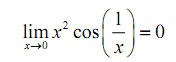
1859_limit57.png

We can check this with the graph of the three functions.  This is illustrated below.
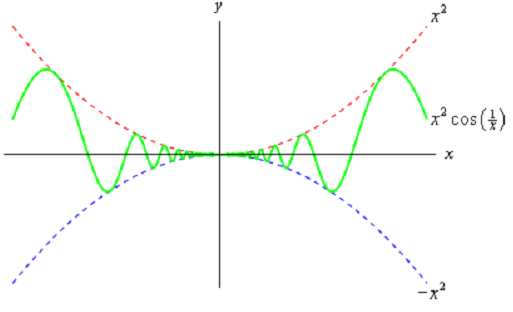
2107_limit58.png


Related Discussions:- Evaluate limit

Fractions, a boy is six months old his sister was given birth to three mont...

a boy is six months old his sister was given birth to three month after him. if their cousin is 0.33years old, arrange their ages in ascending order

Logarithms, We know that 2 4 = 16 and also that 2 is referred to as ...

We know that 2 4 = 16 and also that 2 is referred to as the base, 4 as the index or power or the exponent. The same if expressed in terms of logarithms would be log 2

Sketch the plot first-order integrated rate, Show that the first-order inte...

Show that the first-order integrated rate expression can be written as [A] t = [A] 0 e -n(in)t where n represents the number of elapsed halftimes. Sketch the plot of [A] 1

#algebra, what is the answer of 6_5x9_4x3(1_2)

what is the answer of 6_5x9_4x3(1_2)

Operations research, Explain Analytical Models in Operations Research with ...

Explain Analytical Models in Operations Research with Application

Probability - applications of integrals, Probability - Applications of inte...

Probability - Applications of integrals In this final application of integrals that we'll be looking at we are going to look at probability.  Previous to actually getting into

Reduction of order, We're here going to take a brief detour and notice solu...

We're here going to take a brief detour and notice solutions to non-constant coefficient, second order differential equations of the form. p (t) y′′ + q (t ) y′ + r (t ) y = 0

Angles, how do you workout the value of the missing angle

how do you workout the value of the missing angle

Write Your Message!

Captcha
Free Assignment Quote

Assured A++ Grade

Get guaranteed satisfaction & time on delivery in every assignment order you paid with us! We ensure premium quality solution document along with free turntin report!

All rights reserved! Copyrights ©2019-2020 ExpertsMind IT Educational Pvt Ltd