Equilibrium in both the goods and in the money market, Macroeconomics

Assignment Help:

Equilibrium in both the goods and in the money market 

If both the goods- and the money markets are to be in equilibrium...

...if P increases, Y must fall and R increase ...

...if P decreases, Y must increase and R fall

 For a given P, we can use IS and LM curves to find equilibrium values of interest rate and GDP. Though we can also determine how the equilibrium values of R and Y depend on P. 
2069_Equilibrium in both the goods and in the money market1.png

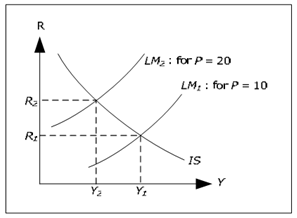
Figure: How P affects the equilibrium in the goods and money market

LM1 is the LM curve when P = 10, whereas LM2 is the LM curve when P = 20. LM2 is above LM1. If Y1 and R1 are the equilibrium values when P = 10 and Y2 and R2 are equilibrium value when P = 20, we see that Y2< Y1 and R2> R1.

We may draw the following conclusion. When prices increase, GDP should fall and interest rates should increase if both the goods and money market is to be in equilibrium. Economic intuition is something like following:

1. When P increases, demand for money increases 

2. When MD increases, interest rate increases

3. When R increases, investments fall 

4. When I falls, GDP falls

Of less significance is the following point: when GDP falls in step 4, MD will fall slightly - however not as much as it increased in step 1. So interest rate will decline slightly compared to the level in step 2.  

More significantly, we no longer have a unique equilibrium from money market and goods market.  As there is a unique LM curve for each value of P, there is an equilibrium (in both markets) for each value of P. 

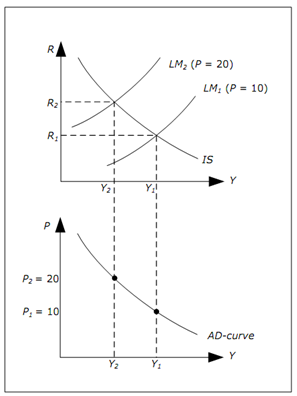
The AD curve shows all combinations of P and Y where the goods and themoney markets are both in equilibrium. The AD curve slopes downwards.

From the section above, we know that Y should fall if P increases if we want both markets to remain in equilibrium. In this unit we derive the exact relationship between P and Y when both markets are in equilibrium. 
1124_Equilibrium in both the goods and in the money market.png

Figure: Derivation of the AD curve

We can explain our derivation using the diagram above.

1. First select P1 = 10 and P2 = 20 in the lower diagram.

2. Draw IS curve in the upper diagram and two LM curves - the one corresponding to P = 20 should be above the one for P = 10. 

3. Identify resulting GDP in the upper graph for both prices - the highest level of GDP is associated with lower of the prices. 

4. Extend these levels of GDP to lower graph. This will lead to two points in the lower graph. 

5. Keep on doing this with other prices. Resulting downward sloping curve in the lower graph is known as the AD-curve. 

Keep in mind that both goods market and money market is in equilibrium at all points on the AD curve. Thus AD-curve alone can't identify to which point the economy will move.


Related Discussions:- Equilibrium in both the goods and in the money market

Equilibrium and disequilibrium, Equilibrium and Disequilibrium  In phys...

Equilibrium and Disequilibrium  In physical sciences, equilibrium is a state of balance between opposing forces or actions. The meaning of equilibrium in economic theory is exa

What is monetary base, What is Monetary base The monetary base is defin...

What is Monetary base The monetary base is defined as the total value of all currency (banknotes and coins) outside the central bank and commercial banks' (net) reserves with t

What do you mean by the long run outcome, Imagine a firm with the same cost...

Imagine a firm with the same cost structure but in each of the four market structures: Competitive, Monopolistically Competitive, Oligopoly, and a Monopoly. Using the concepts of c

What would be due process require in circumstances, The Russ College of Eng...

The Russ College of Engineering and Technology of Ohio University announced in a press conference that it had found "rampant and flagrant plagiarism" in the theses of mechanical en

Perfect competion, discuss the contention that the existance of a labour ma...

discuss the contention that the existance of a labour market in a perfect competion is a fallacy

State about the gross domestic product, Gross domestic product Definit...

Gross domestic product Definition Perhaps the most significant concept in macroeconomics is Gross Domestic Product (GDP): Gross Domestic Product (GDP) is defined as the

Credit multiplier, How to calculate credit multiplier with the value of dep...

How to calculate credit multiplier with the value of deposit, reserves requirement and loan

Short-run framework, What is the difference between the short-run framework...

What is the difference between the short-run framework and the long-run framework? Discuss how each relates to supply and demand.

Liquidity preference theory, Explain clearly the liquidity preference theo...

Explain clearly the liquidity preference theory of interest propounded by j.m.keynes

Consumption, what is the impact of interest rate in consumption

what is the impact of interest rate in consumption

Write Your Message!

Captcha
Free Assignment Quote

Assured A++ Grade

Get guaranteed satisfaction & time on delivery in every assignment order you paid with us! We ensure premium quality solution document along with free turntin report!

All rights reserved! Copyrights ©2019-2020 ExpertsMind IT Educational Pvt Ltd