Engine protection devices - aircraft engine, Other Engineering

Assignment Help:

Engine protection devices :

Described below are typical protection devices that will override any excessive demands made on the engine by the pilot or by the control units.

TOP TEMPERATURE LIMITER.

Turbine gas temperature is measured by thermocouples in the jet pipe. When maximum temperature is reached, these pass a signal to an amplifier, which limits pump stroke by reducing pump servo pressure or moves the throttle valve in series with the pilot.

POWER LIMITER.

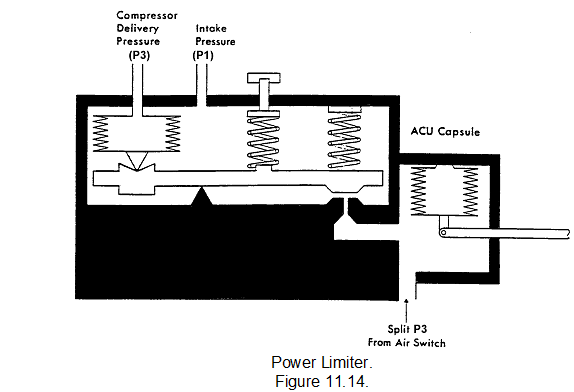
A power limiter is fitted to some engines to prevent over-stressing due to excessive compressor outlet pressure during high-speed, low altitude running. The limiter (see figure) takes the form of a half-ball valve which is opened against a spring force when compressor outlet press (P3) reaches its maximum value. The half-ball valve bleeds off air pressure to the ACU control capsule, thus causing the ACU to reduce pump stroke.
1399_engine protaction device.png

OVERSPEED GOVERNOR.

The engine is protected against over-speeding by a governor, which, in hydro-mechanical systems, is usually fitted on the fuel pump and acts by bleeding off pump servo fuel when the governed speed is reached. On two-spool engines, the pump is driven from the HP shaft and the LP shaft is protected by either a mechanical governor or an electro-mechanical device, again acting through the hydro-mechanical control system. There are two types of pump-driven governors:

Centrifugal Governor.

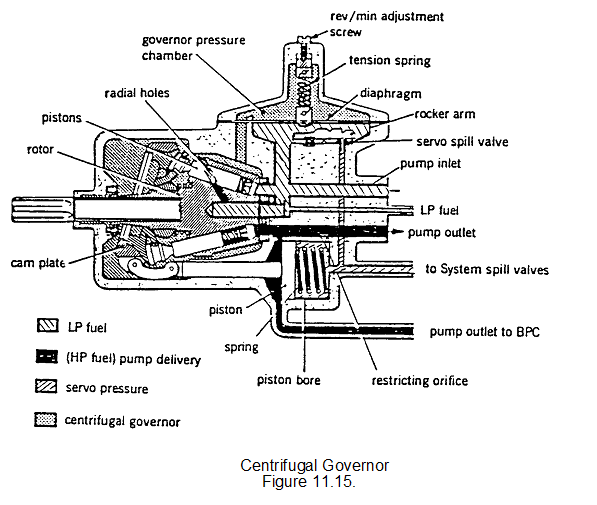
The centrifugal type of governor uses the centrifugal pressure of fuel in radial drillings in the fuel pump rotor to deflect a diaphragm at maximum speed. The diaphragm operates on a half-ball valve to reduce pump servo pressure and thus pump stroke. The disadvantage of this type is that it needs to be reset if fuel specific gravity changes. It is seldom used on modern engines.
1115_engine protaction device1.png 
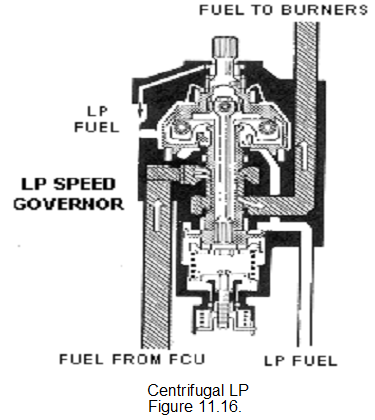
Centrifugal governors using bob weights are used as LP shaft governors on some engines. They will return fuel to low pressure when the LP shaft overspeeds see figure.
1934_engine protaction device2.png

Hydro-mechanical Governor.

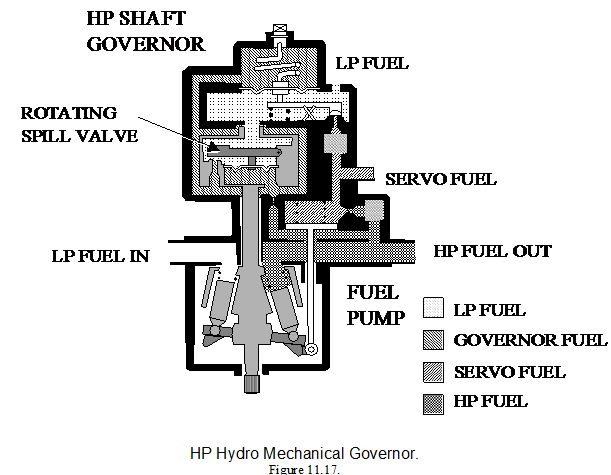
In the hydro-mechanical governor the pump drive shaft rotates a rotor containing a half-ball valve on a lever arm (shown in the figure). As engine speed increases, centrifugal force closes the valve, increasing the pressure of fuel in the governor housing (governor pressure) by restricting its flow to LP. When the maximum speed is reached, governor pressure is high enough to deflect a diaphragm, which opens the half-ball valve acting on pump servo. A hydro-mechanical governor does not require adjustment for changes in fuel specific gravity.
978_engine protaction device3.png


Related Discussions:- Engine protection devices - aircraft engine

Paint, What are the ingredients of paint. Explain?

What are the ingredients of paint. Explain?

Fiancial managment, Suppose you borrow $10,000 at 10% and you are going to ...

Suppose you borrow $10,000 at 10% and you are going to make monthly payments of $2,500. How long until you pay off the loan?

Explain derivatives in terms of capital markets, Explain derivatives in ter...

Explain derivatives in terms of capital markets The term mixture indicates that it has no separate value that is its value is entirely resulting from the of the actual resources

Internal rate of return: multiple alternatives, Internal Rate of Return: Mu...

Internal Rate of Return: Multiple Alternatives To compare multiple alternatives using the IRR as measure of economic worth we must use the incremental approach. It is erroneou

How do comets get their tails, How do comets get their tails? - Most comet...

How do comets get their tails? - Most comets stay frozen in the outer solar system. Only a few enter the inner solar system where they can grow tails. - When a comet nears the sun

Logic gate-nor gate, NOR Gate: Figure shows a further example of a 2 in...

NOR Gate: Figure shows a further example of a 2 input digital gate, again consisting of two NPN transistors, TR1 and TR2, in a different configuration. When input A and input

Casting alloys, Casting Alloys are -             (i) Permanent moulds...

Casting Alloys are -             (i) Permanent moulds are commonly used for the casting of grey iron, aluminum alloys and magnesium alloys.             (ii) Slush Casting

Guidance systems , The design and implementation of an autonomous guidance ...

The design and implementation of an autonomous guidance system requires knowledge and an understanding of a wide range of technologies, from the physical dynamics of the vehicle (i

Dynamic balancing principles - aircraft maintenance , Dynamic balancing pri...

Dynamic balancing principles: We must all be familiar with the effects of unbalance in one form or another, but perhaps the most common effect is that arising from wheel unbala

Write Your Message!

Captcha
Free Assignment Quote

Assured A++ Grade

Get guaranteed satisfaction & time on delivery in every assignment order you paid with us! We ensure premium quality solution document along with free turntin report!

All rights reserved! Copyrights ©2019-2020 ExpertsMind IT Educational Pvt Ltd