Dynamic changes in costs: the learning curve, Microeconomics

Assignment Help:

Dynamic Changes in Costs: The Learning Curve

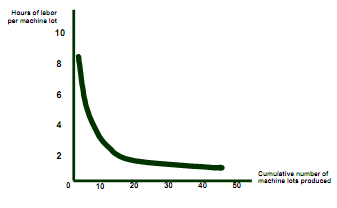
*  The learning curve measures impact of worker's experience on costs of production.

*  It describes relationship between a firm's cumulative output and amount of inputs required to produce a unit of output.
455_learning curve.png

2485_learning curve1.png

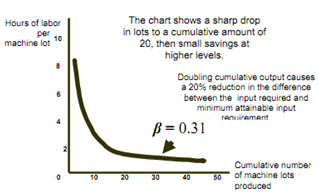
* If N=1

- L equals A + B and this measures labor input to produce the first unit of output

-   If β = 0

- Labor input remains constant as the cumulative level of output increases, cause there is no learning.

* If β > 0 and N increases

- L approaches A, and A represent minimum labor input unit of output after all learning has taken place.

-   The larger β:

- The more important becomes the learning effect.
404_learning curve2.png

* Observations

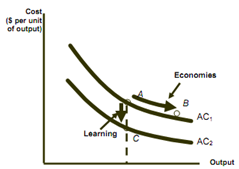
  1) New firms can experience learning curve and not economies of scale.

 2) Older firms have small gains from learning.

Economies of Scale Versus Learning
1650_learning curve3.png

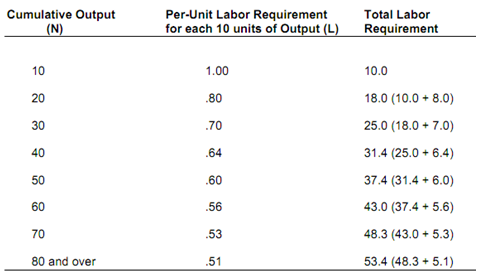
* The learning curve implies:

 1) The requirement of labor falls per unit.

 2) Costs will be high at 1st and then will fall with learning.

 3) After eight years the labor requirement will be 0.51 and per unit cost will be ½ what it was in the 1st year of production? 
653_learning curve4.png


Related Discussions:- Dynamic changes in costs: the learning curve

Balance of payments and developing economies, Balance of Payments and Devel...

Balance of Payments and Developing Economies: It is well-known in development economics that UDCs invariably start as debtor economies. In the process of development itself, t

Monopoly, what is multi-plant monopoly?

what is multi-plant monopoly?

Demand function is homogeneous of degree zero, Demand Function is Homogeneo...

Demand Function is Homogeneous of Degree Zero: Mathematical Presentation  we will show that demand function is homogeneous of degree zero in prices and money income. In o

Explain how a floating exchange rate works, Explain how a floating exchange...

Explain how a floating exchange rate works and the variables which affect the rate. Define a floating exchange rate as the price of a currency (in terms of another or basket of

Ricardian model - production possibilities frontier, Suppose there are two ...

Suppose there are two countries (home and foreign) and that two goods can be produced within those countries: machinery (M) and bread (B). Marginal product of labor (MPL) is given

Narrowness of definition of the commodity, Explain why each of the followin...

Explain why each of the following factors may influence the own price elasticity of demand for a commodity. (i) Consumer preferences, that is, whether consumers regard the commodi

Derived demand, Derived demand and Demand schedule: D erived demand...

Derived demand and Demand schedule: D erived demand is where the demand for a final product leads to the demand for a second product which is used to produce this final p

Write Your Message!

Captcha
Free Assignment Quote

Assured A++ Grade

Get guaranteed satisfaction & time on delivery in every assignment order you paid with us! We ensure premium quality solution document along with free turntin report!

All rights reserved! Copyrights ©2019-2020 ExpertsMind IT Educational Pvt Ltd