Digital computer, Basic Computer Science

Assignment Help:

Digital computer:

In the digital computer there are basically two types of input, namely Instructions, and Data from the various radio and non-radio sensors, which will be referred to collectively as information. Information must of course, be coded into a form, which the rest of the computer can understand, such as digital form.

The essential components of a digital computer are shown in Figure.
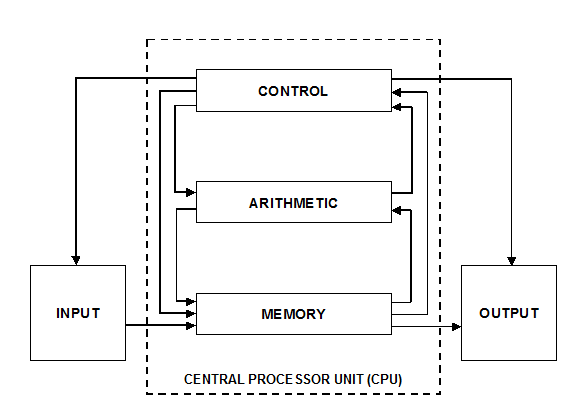
629_digital computer.png

Coded information is passed to the memory in which it is stored until needed by the other units. The memory is divided into a large number of cells, each of which can store a word representing a piece of information. Each cell has a unique address, through which access to the information contained within that cell can be obtained. There are usually two types of memory, long term and temporary stores. The latter, often termed registers, will be used to hold intermediate results in calculations and data, which is to be processed next in the calculating sequence.

The arithmetic unit performs the actual arithmetic operations called for by instructions. It can be compared with a calculator.

The results of the calculations must be displayed in a suitable form easily interpreted by the pilot. This is the function of the output unit, which reads from the store.

The control unit directs the overall functioning of the computer according to the program of instructions in store. This program is known as software as opposed to the actual circuitry, which is termed hardware. Although control is drawn as a separate unit in the functional block diagram, the control hardware, which comprises timing circuits and electronic switches, is spread throughout the computer.

Information is read into the appropriate address of the store under the control of the software. In aircraft navigation applications, incoming data from sensors updates the contents of the store at a rate dependent upon the timing of the computer control.

The control acts on instructions held in store in the appropriate sequence. The basic task will be to transfer data from store to the arithmetic unit, to carry out the necessary calculations using registers to store the intermediate results, then writing the final result into the store.

The final control function will be to transfer data from store to the output as a result of built in instructions, or on specific instructions from the pilot.

This process of input - store - calculate - store - output is carried out sequentially in accordance with software requirements.


Related Discussions:- Digital computer

Explain the role of it in bpr, Question 1. Explain the levels of managemen...

Question 1. Explain the levels of management? Question 2. What are the advantages and disadvantages of DBMS Question 3. What are the advantages and disadvantages o

Application-specific multiprocessors, Application-Specific Multiprocessors ...

Application-Specific Multiprocessors Although this book details a variety of similar architectures, it specializes in the design of such architectures in the perspective of par

Create a flowchart that displays the student''s avera, Ask questiCreate a f...

Ask questiCreate a flowchart that displays the student''s average score for three quizzes. + Assume that there are 3 sections each having 5 students + The only valid number to be

Languages, Languages The language is a program containing rules and...

Languages The language is a program containing rules and guidelines to help us in making programs. There are various languages like C, Basic, COBOL, PASCAL, FORTRAN etc. Th

Application software, APPLICATION SOFTWARE Application Software ...

APPLICATION SOFTWARE Application Software generally is the software which is used to generate customized applications for the clients. Ex: Word Star, Lotus 1-2-3, Ms-

Wcdma – fdd technology, WCDMA – FDD technology Multiple access technology i...

WCDMA – FDD technology Multiple access technology is wideband CDMA (WCDMA) All cells at same carrier frequency Spreading codes used to separate cells and users Signal bandwidth 3.8

Explain FDM : Frequency Division Multiplexing, Frequency Division Multiplex...

Frequency Division Multiplexing : FDM is an analog technique that is applied when he bandwidth of link is greater than the combined bandwidth of the signals to be transmitted. a

Kirchhoff’s law, A car battery is of 12 V. Eight dry cells of 1.5 V each ...

A car battery is of 12 V. Eight dry cells of 1.5 V each connected in series can give 12 V. But such cells are not used in starting a car. Why?

Telecommunications network, Telecommunications network: "A telecommuni...

Telecommunications network: "A telecommunications network, at its simplest, may be regarded as comprising a transmission network, an arrangement of transmission paths and swit

Write Your Message!

Captcha
Free Assignment Quote

Assured A++ Grade

Get guaranteed satisfaction & time on delivery in every assignment order you paid with us! We ensure premium quality solution document along with free turntin report!

All rights reserved! Copyrights ©2019-2020 ExpertsMind IT Educational Pvt Ltd