Different models of computation-parallel algorithms, Computer Networking

Assignment Help:

There are various computational models for representing the parallel computers. In this part, we discuss various models. These models would give a platform for the designing as well as the analysis of the parallel algorithms.

Combinational Circuits

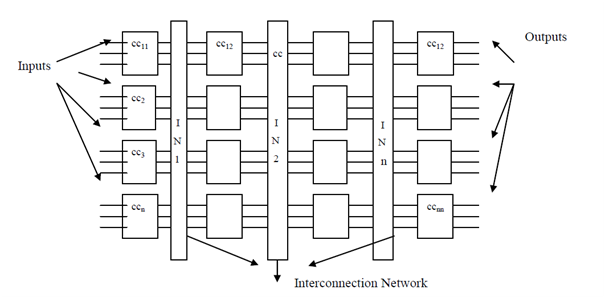
Combinational Circuit is one of the forms for parallel computers. In interconnection networks, many processors communicate with each other directly and do not need a shared memory in between. Mostly, combinational circuit (cc) is a connected arrangement of logic gates with a set of m input lines and a set of n output lines as given in Figure. The combinational circuits are mostly made up of various interconnected components arranged in the form called as stages as given in Figure.

587_Combinational circuit.png

                                                                          Combinational circuit

2413_Detailed combinational circuit.png

Detailed combinational circuit

It might be noted here that there is no feedback control employed in combinational circuits. There are a small number of terminologies followed in the context of combinational circuits such as fan in and fan out. Fan in indicates the number of input lines attached to each device and fan out indicates the number of output lines. In Figure , the fan in is 3 and fan out is also 3. The following parameters are used for analyzing a combinational circuit:

1)  Depth: It means that the total number of phases used in the combinational circuit starting from the input lines to the output lines. For example, in the depth are 4, as there are four different phases attached to a interconnection network. The other form of interpretation of depth can be that it represents the worst case time complexity of resolving a problem as input is given at the initial input lines and data is transmitted between various phases through the interconnection network and at the end reaches the output lines.

2) Width: It represents the total number of devices attached for a particular phase. For example in Figure, there are 4 components linked to the interconnection network. It means that the width is 4.

3)  Size: It represents the total count of devices used in the complete combinational circuit. For example, in Figure , the size of combinational circuit is 16 i.e. (width * depth).


Related Discussions:- Different models of computation-parallel algorithms

Define the method of encryption and decryption using by ssl, Encryption/dec...

Encryption/decryption using by SSL Once a session is established, the SSL generates a session key using public-key encryption to exchange information between the client and ser

Define firewall and its uses, Firewall is a device or a component that res...

Firewall is a device or a component that restricts access between a protected or an internal network from an external or untrustworthy network .A firewall basically limits unautho

Error correction, discuss the concept of redundancy in error detection and ...

discuss the concept of redundancy in error detection and correction

The concept of universal service, The major problems with multiple networks...

The major problems with multiple networks are as given: A computer attached to a given server can only interact with other computers attached to the similar network.

Telecoms, What is a Multiplexor

What is a Multiplexor

Lan- wan network module expansion slot, WAN interface card(WIC) slots T...

WAN interface card(WIC) slots Two fixed WIC slots are present in  2600 series router except 2691. It has contained 3 WIC slots. Network Module Expansion Slot( NM) slot

Subnetting (EIGRP), #questiGE 1-A Objectives: • Consolidate EIGRP knowle...

#questiGE 1-A Objectives: • Consolidate EIGRP knowledge. • Introduce the Route Redistribution concept. • Introduce the EIGRP External Routes concept. • Introduce the Default Met

Network ownership, NETWORK OWNERSHIP:   There are two types in this ...

NETWORK OWNERSHIP:   There are two types in this case: 1. Private Network 2. Public Network

Layers, Layers, Massages, Segments, Datagram's and Frames Figure 2.15 ...

Layers, Massages, Segments, Datagram's and Frames Figure 2.15 show the physical  path data takes down a  sending  end  systems  protocol  stack up and  down the  protocol stac

Write Your Message!

Captcha
Free Assignment Quote

Assured A++ Grade

Get guaranteed satisfaction & time on delivery in every assignment order you paid with us! We ensure premium quality solution document along with free turntin report!

All rights reserved! Copyrights ©2019-2020 ExpertsMind IT Educational Pvt Ltd