Dielectric Heating
Dielectric losses occur in insulating materials. These are same as hysteresis losses in magnetic materials. When an alternating electric field is applied to an insulating materials due to inter atomic friction the atoms get stressed and heat is produced. This inter atomic friction caused by repeated deformation and rotation of atomic structure constituting the dielectric due to which dielectric loss occurs.
An atom of any materials has a nucleus with a net positive charge at the centre and negatively charged electrons surrounding the nucleus. Shown that when there is no electric field the centred of positive and negative charge are coincided. As the electric field is applied to the atom the positive charge of the nucleus is forced in the direction of field and the negative charge is forced in the opposite direction of field as shown in figure .
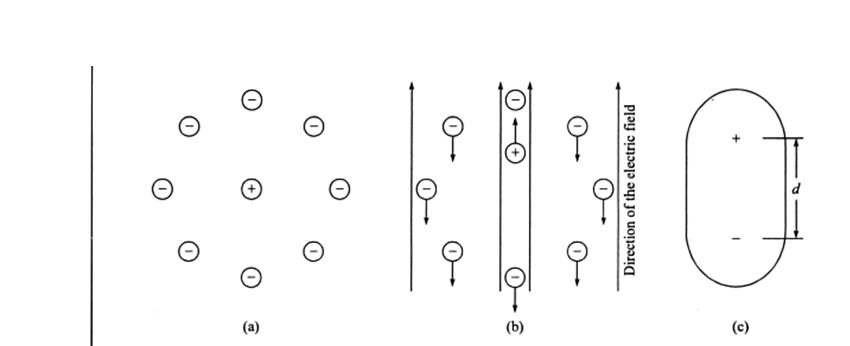
figure (a) An atom without electric field(b) an atom with electric field and (c) equivalent of
Let the two centres are displaced by a distance d as shown in figure. This gives rise to the electric dipole moment of magnitude P= qd. This state is known as polarization. With increase in electric field strength the degree of polarization is increased. At a certain value of electric fields all electric dipoles align themselves. In this condition the dielectric material is said to be saturated. This state is shown in figure .
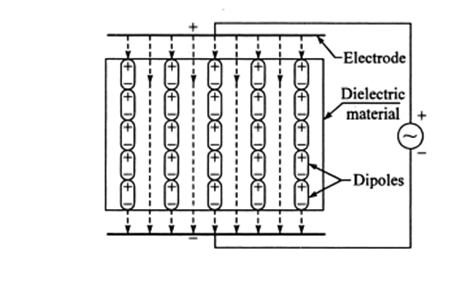
Figure Alignment of electric dipoles
In dielectric heating it is desirable to use high frequency instead of high voltage. If very strong electric field is applied to insulating material then it may possible.
That the strong electric fields may brings out electron form the orbit resulting in a rupture of the dielectric medium. Therefore the applied voltage should always below the breakdown values.
The principle of operation of dielectric heating can be explained by an example. Consider a piece of insulator. When an alternating voltage is applied across this an electric current flows. Which may have two component capacitive current and resistive current. Obviously leads applied voltage by 900 and iR will be phase with v as shown in figure.

Figure (a) Dielectric heating of a insulating material (b) equivalent circuit (c) phase or diagram
It behaves like a insulating resistance parallel to capacitor as shown in figure the dielectric loss appears in the form of heat in the dielectric of the capacitor.