Determining the value at a node or backward induction, Financial Management

Assignment Help:

The value of node is determined using a methodology called backward induction. The value at any node depends on the future cash flows; therefore, we need to start from the last year in the tree and work backwards to get the required solution. For example, if we want to find the value at node T, we need to first calculate the value at node TH and TL and to find the value of bond at node TH; also, we need to first calculate the value of the bond at nodes THH and THL which is nothing but the future cash flows. The future cash flows depend on two factors. First, the coupon payment one year from now; and second, the bonds value one year from now. We have already seen that at every node there are two options and the node can take a higher or lower value. Therefore, the cash flow at a node can either be the bond value if the 1-year rate is higher rate plus the coupon payment or the bond value if the 1-year rate is lower rate plus the coupon payments. Coming back to our example, the cash flow at T will either be bond rate at THH plus coupon rate or the bond rate at THL plus coupon payment.

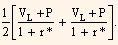
We need to calculate the present value of the expected cash flow to get the bond value at a node. We get two present values in each case, one is the present value if the 1-year rate is higher and the other if it is lower. As we have two options with equal probability, an average of the two present values is computed.

VH     =       Higher 1-year rate value of the bond.

VL       =       Lower 1-year rate of the bond.

P       =       Coupon payment.

r*      =       1-year rate at the node where the valuation is sought.

Therefore, the cash flow at a node is

VH + P for the higher 1-year rate (or)

VL+ P for the lower 1-year rate.

Present value of the cash flows using the 1-year rate at the node, is calculated as follows:

Present value for the higher rate = 256_determining value at node.png

Present value for the lower rate = 2381_determining value at node1.png

The value of the bond at the node is 2234_determining value at node2.png


Related Discussions:- Determining the value at a node or backward induction

Capital, Additional Paid in Capital - Amounts paid for stock in excess of ...

Additional Paid in Capital - Amounts paid for stock in excess of its PAR VALUE or STATEDVALUE. Furthermore, other amounts paid by stockholders and charged to EQUITY ACCOUNTS other

Translation process among the monetary/nonmonetary method, Explain the dist...

Explain the distinction in the translation process among the monetary/nonmonetary method and the temporal method. Answer:  Within the monetary or nonmonetary method, every mone

Option-adjusted spread (oas), Option-Adjusted Spread (OAS) The prime ob...

Option-Adjusted Spread (OAS) The prime objective of an investor is to buy securities which have values greater than their market prices. The discussion made on the above valuat

#title Find the NPV of 2 Projects, Woody Construction is considering a new ...

Woody Construction is considering a new 3 year expansion project that requires an initial fixed asset investment

Bonds with embedded put options, Put option is the right of the inves...

Put option is the right of the investor which he may exercise on the date at the put price given in the indenture. Normally, put price is in par value. When yield rises

Assignmebt solution, Select a company (excluding finance sector) of Bursa M...

Select a company (excluding finance sector) of Bursa Malaysia (www.bursamalaysia.com). Analyse and comment on the liquidity and profitability performance of the selected company fr

Passive management, In the efficient markets, whether it is sec...

In the efficient markets, whether it is security, equity or fixed-income markets it is believed that the investors use some type of passive strategy in

Student, applicability of an operating cycle in vegetable growing in uganda...

applicability of an operating cycle in vegetable growing in uganda

Compute the economic order quantity, Q. Compute the economic order quantity...

Q. Compute the economic order quantity? TNG has a current order size of 50000 units Average number of orders per year = demand/order size = 255380/50000 = 5·11 orders Ann

Write Your Message!

Captcha
Free Assignment Quote

Assured A++ Grade

Get guaranteed satisfaction & time on delivery in every assignment order you paid with us! We ensure premium quality solution document along with free turntin report!

All rights reserved! Copyrights ©2019-2020 ExpertsMind IT Educational Pvt Ltd