Demand for risky assets, Microeconomics

Assignment Help:

Demand for Risky Assets

*  Assets

- Something which provides a flow of money or services to its owner.

-  The flow of money or services can be explicit or implicit .

*  Capital Gain 

- An increase in value of an asset, while the decrease is a capital loss.

*  Risky & Riskless Assets

- Risky Asset 

  • Provides uncertain flow of money or services to the owner.
  • Examples

- Apartment rent, corporate bonds, capital gains, stock prices

- Riskless Asset

  • Provides flow of money or services which is known with certainty.
  • Examples

- Short term government bonds, short term certificates of deposit

*  Asset Returns

- Return on an Asset

-  The total monetary flow of asset as fraction of its price.

- Real Return of an Asset

-  The simple return less the rate of inflation.

*  Asset Returns

  Expected versus Actual Returns

- Expected Return

  • Return which an asset should earn on average

- Actual Return

  • Return which an asset earns

- Higher returns are associated with the greater risk.

- The risk averse investor should balance risk relative to return

* Risk and Budget Line

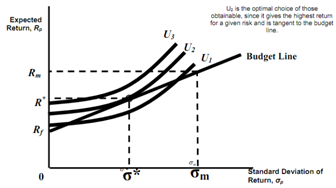
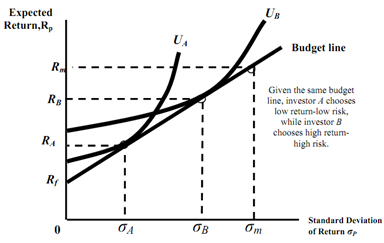
  Expected return, RP, increases as the risk increases.

 The slope is price of risk or risk-return trade-off.

Choosing Between Risk and Return
493_choices of two different investors.png

The Choices of Two Different Investors
151_choices of two different investors1.png


Related Discussions:- Demand for risky assets

Short run versus long run, The Short Run versus long Run - Short-run: ...

The Short Run versus long Run - Short-run: Period of time in which the quantities of one or more production factors cannot be changed. These inputs are called as fi

Why government cannot print new currency to pay the debts, Why government c...

Why government cannot print new currency to pay the debts?  When there is deficiency of internal resources then government borrow. Government can borrow either from central ban

The theory of demand :the utility approach, Prove that the utility approach...

Prove that the utility approach and the indifference curve approach yield the same consumer equilibrium.

What are the goal of sustainability, The goal of sustainability requires th...

The goal of sustainability requires that we address what three questions? The goal of sustainability needs that we address whether economic activities are financially sustainab

A significant majority of consumers, Normal 0 false false f...

Normal 0 false false false EN-IN X-NONE X-NONE MicrosoftInternetExplorer4 The demand schedule c

Explain the different types of unemployment that exist, Problem 1: a) E...

Problem 1: a) Explain the different types of unemployment that exist. b) Critically examine how monetary policy can be used to deal with inflation. c) Critically examine

Problems using point elasticity, Problems Using Point Elasticity - We m...

Problems Using Point Elasticity - We may need to compute price elasticity over portion of demand curve instead of at a single point. - The price and quantity used as base wi

Kaldor hicks, limitation of kaldor hicks in compensation test and welfare c...

limitation of kaldor hicks in compensation test and welfare criteria

Internal rate of return, If, for a specific project alternative, the discou...

If, for a specific project alternative, the discount rate equals the Internal Rate of Return, then the (discounted) Benefit Cost Ratio will equal unity (i.e., BCR=1.0). Define I

Write Your Message!

Captcha
Free Assignment Quote

Assured A++ Grade

Get guaranteed satisfaction & time on delivery in every assignment order you paid with us! We ensure premium quality solution document along with free turntin report!

All rights reserved! Copyrights ©2019-2020 ExpertsMind IT Educational Pvt Ltd