Define atmospheric energy - thermodynamics, Physics

Assignment Help:

Define Atmospheric Energy - thermodynamics?

The mass of the Earth's atmosphere, p(z), varies with height z above the Earth's surface. Assume that the "thickness" of the atmosphere is adequately small so that it is in a uniform gravitational field of strength g.

a) Write an equation to conclude the atmospheric pressure given the function p(z).

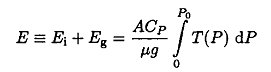
b) In a static atmosphere, each parcel of air has an internal energy ΔEi and a gravitational potential energy ΔEg. To a very good approximation, the air in  the atmosphere is an  ideal gas with constant specific heat. By means of this assumption, the result of part (a), and classical thermodynamics, shows that the total energy in a vertical column of atmosphere of cross-sectional area A is given by
474_Atmospheric Energy 1.png

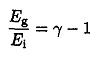
And that the ratio of energies is

1843_Atmospheric Energy 2.png

Where T is the temperature, Po is the pressure at the Earth's surface, μ is the molar mass, Cp is the molar specific heat at constant pressure, and g≡Cp/Cv is the ratio of specific heats.

Hint: The above results do not depend on the specific way in which P(z), T(z), and p(z) vary as a function of z (e.g., isothermal, adiabatic, or something intermediate). They depend only on the fact that P(z) is monotonically decreasing. At a few step of the derivation you might find it useful to do integration by parts.


Related Discussions:- Define atmospheric energy - thermodynamics

What is elasticity, The characteristic of a body by virtue of which the bod...

The characteristic of a body by virtue of which the body takes its real configuration when external deforming forces are removed is called as elasticity.

How is radiation release from the body, Q. How is radiation release from th...

Q. How is radiation release from the body? Answer:- The body radiates energy by thermal conduction through the skin to the clothes, air, and so on around the body. A littl

Q, #question 1:successive disintegration in nucluer physics

#question 1:successive disintegration in nucluer physics

Newton''s ring, in newton''s rings experiment the diameter of the nth and n...

in newton''s rings experiment the diameter of the nth and n+14 rings are 3.2mm and 6mm respectively.Radius of curvature of plano convex lens is 1m.Calculate wavelength of light.

Derive the conservation law, Suppose a fluid (say, water) occupies a domain...

Suppose a fluid (say, water) occupies a domain D ⊂ R 3 and has velocity field V=V(x, t). A substance (say, a day) is suspended into the fluid and will be transported by the fluid

Heat, what is thermal conductivity ?

what is thermal conductivity ?

Optics, determination of suger concentration in water by refractive index

determination of suger concentration in water by refractive index

Determine the value of convection mass transfer coefficient, On a summer da...

On a summer day the air temperature is 27° C and the relative humidity is 30%. Water evaporates from the surface of a lake at a rate of 0.10 kg/h per square meter of water surface

Illustrate why does a tilted gyroscope not fall, Q. Illustrate why does a t...

Q. Illustrate why does a tilted gyroscope not fall? Answer:- Depiction a spinning gyroscope that has its axis of rotation tilted with respect to gravity. Since the gyrosco

Define electric field, Electric Field: The electrical field because of ...

Electric Field: The electrical field because of a charge can be described as the space around the charge.

Write Your Message!

Captcha
Free Assignment Quote

Assured A++ Grade

Get guaranteed satisfaction & time on delivery in every assignment order you paid with us! We ensure premium quality solution document along with free turntin report!

All rights reserved! Copyrights ©2019-2020 ExpertsMind IT Educational Pvt Ltd