Decision trees - artificial intelligence, Computer Engineering

Assignment Help:

Decision Trees - Artificial intelligence:

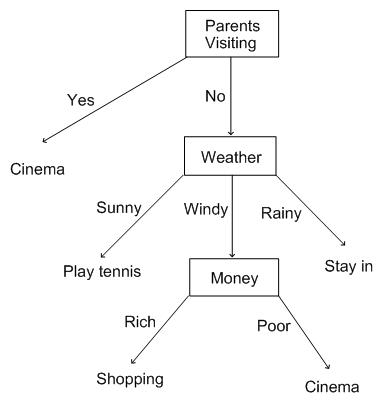
Suppose you just ever do four things at the weekend: go shopping, watch a film, play tennis or just stay inside.  What you do depends on three things: the weather (windy, sunny or rainy); how much money you have (poor or rich) and whether your parents are tripping. You say to your yourself: if my parents are visit, tripping we'll go to the movie. If they're not tripping and also it's sunny, then I'll go for tennis, but if it's windy , and I'm wealthy, then I'll go shopping. If they're not tripping, it's windy and I'm poor, then I will go to the movie. If they're not tripping and it's rainy, then I'll stay inside.

To keep in mind all this, you draw a flowchart which will permit you to read off your conclusion. We call such diagrams decision trees. A fit decision tree for the weekend decision choices would be as follows:
 

998_Decision Trees.png

We may see that why such diagrams are called trees, because, while they are admittedly upside down, they start from a root and having branches leading to leaves (the tips of the graph at the downside). Note that the leaves are always decisions, and a particular decision should be at the end of various branches (for example, we might choose to go to the cinema for two different reasons).

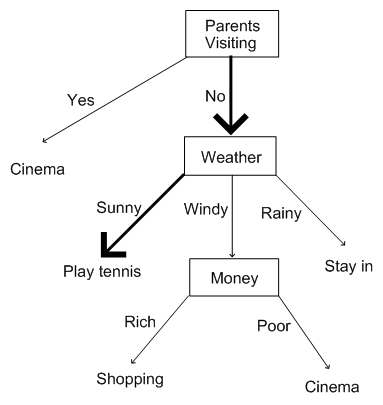
Armed with our decision tree, on Saturday morning, when we rise up, all we have to do is check (a) the weather (b) how much money we have and (c) whether our parent's car is parked in the drive. The decision tree will then allow us to form our choice. assume, for example, that the parents haven't turned up and the sun is shining. Then this way through our decision tree will tell us what to do:
 

1681_Decision Trees1.png

and hence we run off to play tennis because our decision tree informed us to. Notice that the decision tree covers all eventualities.  That is,  there are  no  values that  the weather conditions, the parents turning up or the money condition must take which aren't provided for in the decision tree. Note that, in this lecture, we will be looking at how to repeatedly produce choice trees from examples, not at how to turn thought methods into decision trees.


Related Discussions:- Decision trees - artificial intelligence

Returns the information about tasks running, Returns the information about ...

Returns the information about tasks running int info = pvm_tasks( int where, int *ntask, struct pvmtaskinfo **taskp ) struct pvmtaskinfo {  int ti_tid; int ti_pt

What is fork swap, What is Fork swap? "Fork ()" is a system call to mak...

What is Fork swap? "Fork ()" is a system call to make a child process. When the parent process calls "fork()" system call, the child process is formed and if there is short of

Explain program source code, Q. Explain Program Source Code? Program S...

Q. Explain Program Source Code? Program Source Code  Every assembly language statement appears as: {identifier}  Keyword {{parameter},}  {;comment}.   Element of a

Odd-even merging circuit, Odd-Even Merging Circuit Let's firstly unders...

Odd-Even Merging Circuit Let's firstly understand the idea of merging two sorted sequences using an odd-even merging circuit. The functioning of a merging circuit is as given b

Single instruction and multiple data stream (simd), Single Instruction and ...

Single Instruction and Multiple Data stream (SIMD) In this organisation, multiple processing elements are working under the control of a one control unit. It has multiple data

What is a table cluster, What is a table cluster? A table cluster join...

What is a table cluster? A table cluster joins several logical tables in the ABAP/4 Dictionary.  Various logical rows from different cluster tables are brought together in a o

Uneven load distribution in parallel computers, Q. Uneven Load Distribution...

Q. Uneven Load Distribution in parallel computers? In parallel computers the problem is split in sub-problems in addition is assigned for computation to several processors howe

What are the techniques of data collection, What are the techniques of Data...

What are the techniques of Data Collection It can be either automatic or manual. Manual techniques can include: -  Keypads/Keyboards to type in data -  touch screens to s

What is use case and use case diagram, What is use case and use case diagra...

What is use case and use case diagram? A use case is a coherent piece of functionality that a system can give by interacting with actors. Use case includes one or more actors a

Determine the nand gate, Find out the two inputs when the NAND gate output ...

Find out the two inputs when the NAND gate output will be low. Ans. The output of NAND gate will be low if the two inputs are 11. The Truth Table of NAND gate is shown

Write Your Message!

Captcha
Free Assignment Quote

Assured A++ Grade

Get guaranteed satisfaction & time on delivery in every assignment order you paid with us! We ensure premium quality solution document along with free turntin report!

All rights reserved! Copyrights ©2019-2020 ExpertsMind IT Educational Pvt Ltd