Data rate limitations in PSTN's by using nyquist theorem, Computer Engineering

Assignment Help:

Explain with the help of Nyquist theorem, the data rate limitations in PSTN's.

Data rates in PSTNs: A voice channel in a public switched telephone network is band restricted with a nominal bandwidth of 3.1 kHz. A first-cut estimate of it can be acquired from Nyquist's theorem that applies to noiseless states and channels:

R = 2H log V bps

Where

R = maximum data rate

H = bandwidth of the channel

V = number of discrete levels in the signal
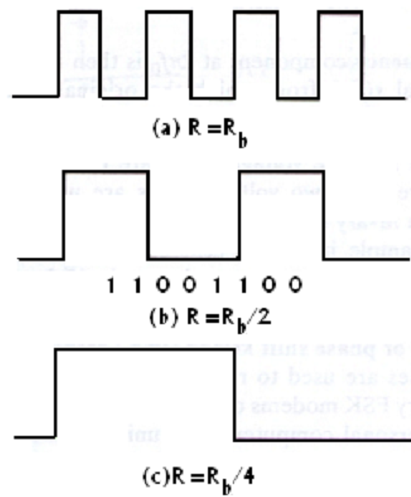
1094_Baud Rates and Bit Rates.png

FIG - Baud Rates and Bit Rates

For a 3-kHz channel and a binary signal, the maximum data rate works out to be 600 bits per second, when the channel is ideal. In the practical channel, the maximum rate would come down. Through increasing the number of levels used to signify the signal, the bit rate may be raised arbitrarily in a noiseless channel. This is significant to recognize that the actual number of signal transitions is even limited to the binary level limit; the effectual bit rate goes up with more than two signal levels when each signal level can represent a group of two or more bits. Now, the maximum rate of signal transitions which can be supported by a channel is termed as baud rate or symbol rate. In a channel, there is an absolute maximum limit for the bit rate where noise is present. This limit occurs since the difference MONG two signal levels becomes comparable to the noise level while the number of signal level is raised.

Claude Shannon, who was extend Nyquist's works to the case of noisy channels influenced by thermal or random noise. Result states of Shannon:

R = H log (1+S/N)

Here R= the maximum bit rate obtainable

H= bandwidth of the channel

S/N = signal to noise ratio.


Related Discussions:- Data rate limitations in PSTN's by using nyquist theorem

Show the fundamental process of instruction execution, Q. Show the fundamen...

Q. Show the fundamental process of instruction execution? The fundamental process of instruction execution is:  1. Instruction is fetched from memory to CPU registers (calle

Illustrate 16-bit isa, Illustrate 16-bit ISA?  Compare it with 8-bit ISA bu...

Illustrate 16-bit ISA?  Compare it with 8-bit ISA bus.  The only difference between 8 and 16-bit ISA bus is that an extra connector is attached behind the 8-bit connector. 16-b

What is source and listener, A source is an object that produces an event. ...

A source is an object that produces an event. This happens when the internal state of that object changes in some way. A listener is an object that is notified when an event happen

Explain working of bit serial associative processor, Q. Explain working of ...

Q. Explain working of Bit Serial Associative Processor? When associative processor accepts bit serial memory organization subsequently it is known as bit serial associative pr

DISCRETE STRUCTURES, SET 2I OF ALL INTEGERS WITH ZERO IS AN ABELIAN GROUP

SET 2I OF ALL INTEGERS WITH ZERO IS AN ABELIAN GROUP

Sem 4, Which are the subject of sem 4?

Which are the subject of sem 4?

Number square, Ask question #MinimYour professor wants you to fill a two-di...

Ask question #MinimYour professor wants you to fill a two-dimensional N by N matrix with some numbers by following a specific pattern. According to his explanation as in the figure

Disadvantages of asynchronous and synchronous reset, What are disadvantages...

What are disadvantages of the asynchronous reset and synchronous reset? Disadvantages of asynchronous reset: Make sure that the release of the reset can arise within one c

Write Your Message!

Captcha
Free Assignment Quote

Assured A++ Grade

Get guaranteed satisfaction & time on delivery in every assignment order you paid with us! We ensure premium quality solution document along with free turntin report!

All rights reserved! Copyrights ©2019-2020 ExpertsMind IT Educational Pvt Ltd