Cross-section of exogenous tree, Civil Engineering

Assignment Help:

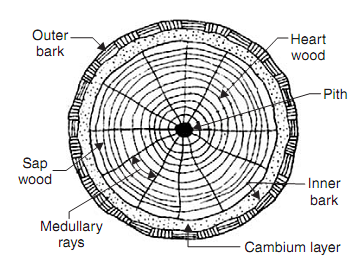
The cross-section of exogenous tree is as shown in given figure.The following components are visible to the naked eye:
1522_cross section of exogenous tree.png

         Cross-section of exogeneous tree

1. Pith: It is the inner most part of the tree and therefore the oldest part of exogeneous tree when the plant becomes old, the pith dies and becomes and dark and fibrous. It varies in shape and size

2. Heart Wood: It is the portion surrounding pith. It is strong and dark in color. This portion is useful for several engineering purpose. It is the dead part of wood. It consists of various annular rings.

3. Sap Wood: It is the layer next to heart wood. It denotes contains sap and recent growth. It takes active part in the growth of trees by permitting sap to move in upward direction. Annual rings of sap wood are less sharply divided and are light in color. The sap wood is also called as alburnum.

4. Cambium Layer: It is a thin layer of fresh sap lying among sap wood and the inner bark. It has sap which is not still converted into sap wood. If the bark is removed & cambium layer is exposed to atmosphere then cells cease to be active and tree dies.

5. Inner Bark: It is a inner skin of tree defensive the cambium layer. It provides protection to cambium layer.

6. Outer Bark: It is the outer skin of the tree and contain of wood fibres. Sometimes it contains cracks and fissures.

7. Medullary Rags: These are thin radial fibers extending from pith to cambium layer. They together hold annular rings. In some of trees they are broken and some other they cannot be prominent.


Related Discussions:- Cross-section of exogenous tree

Mechanics of solids, Ask question #MinThe maximum instantaneous extension, ...

Ask question #MinThe maximum instantaneous extension, produced by an unknown falling weight through a height of 4 cm in a vertical bar of length 3 m and of cross sectional area 5 c

Surveying., with a neat well labelled, explain reciprocal ranging in survey...

with a neat well labelled, explain reciprocal ranging in surveying.

Design the curtain to touch the seabed, Question For fixing of silt cur...

Question For fixing of silt curtains, what is the reason that it does not desirable to design the curtain to touch the seabed ? Answer Silt finished are resistant ve

Determine about the pre-stressed concrete beam, Determine about the pre-str...

Determine about the pre-stressed concrete beam A pre-stressed concrete beam has a width of 200 mm and an overall depth of 400 mm. The permissible stresses in tension and compre

Direct levelling, to find height difference between two or more points in d...

to find height difference between two or more points in different conditions

Landing systems, Landing Systems: There are two basic types of landin...

Landing Systems: There are two basic types of landing, viz : (a) visual landing, when the weather conditions are favourable, and (b) instrumented landing, when the weat

Strenght of meterials 2, Difference between direct and bending stress diagr...

Difference between direct and bending stress diagrams

Foundation, Explain briefly shallow foundation?

Explain briefly shallow foundation?

Write Your Message!

Captcha
Free Assignment Quote

Assured A++ Grade

Get guaranteed satisfaction & time on delivery in every assignment order you paid with us! We ensure premium quality solution document along with free turntin report!

All rights reserved! Copyrights ©2019-2020 ExpertsMind IT Educational Pvt Ltd