Correlation - cause and effect, Applied Statistics

Assignment Help:

Cause and Effect

Even a highly significant correlation does not necessarily mean that a cause and effect relationship exists between the two variables. Thus, correlation does not necessarily imply causation or functional relationship though the existence of causation always implies correlation or association between variables. It might sometimes happen that a fair degree of correlation is observed between the two variables but this is only due to chance as the theory might indicate non-existence of cause and effect relationship. Such a correlation is known as spurious correlation. While interpreting the correlation coefficient, it is necessary to see whether there is any cause and effect relationship between the variables under study. If there is no such relationship, the correlation observed is meaningless.

Figure 1

733_cause and effect.png

Ferrochrome is a material used in the manufacture of stainless steel. Suppose, in recent times there has been such a large increase in the supply of ferrochrome worldwide that its international price has dropped.

The simplified figure above reveals that as supply increased from S1 to S2, prices fell from P1 to P2. Hence, there is an inverse correlation between supply and price, that is, when supply increases, prices fall. Further we can say that the increase in supply was the CAUSE that led to the EFFECT of falling prices. So far so good.

Now consider the figure given below:

Figure 2

1313_cause and effect1.png

Here we have plotted supply against price. We may now be tempted to say that the fall in price from P1 to P2 was the CAUSE that led to the EFFECT of increase in supply from S1 to S2. This does not make economic sense because a fall in price does not lead to an increase in supply. The problem is that we have reversed the cause (increase in supply) and the effect (fall in price).

Continuing the example, suppose supply increases from S1 to S2, but demand increases by a disproportionately larger quantity. As demand increases more than supply the price will increase. In such a case if we plot price against supply the simplified graph would be as follows:

Figure 3
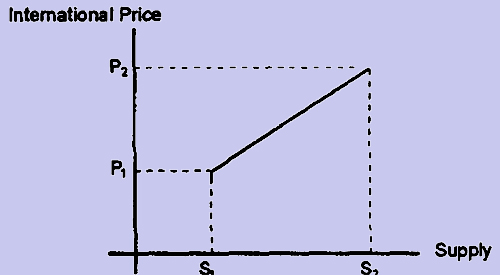
1900_cause and effect2.png

Hence, when supply increases from S1 to S2, price increases from P1 to P2. This is again poor economics because an increase in supply should reduce prices and not increase prices. The problem here is that the main CAUSE for the increase in price is the disproportionate increase in demand which is not shown in the graph. Hence, by ignoring the vital factor of demand and by comparing supply with price we come up with a spurious positive correlation between supply and price which defies good economics.


Related Discussions:- Correlation - cause and effect

Inverse market demand, There are two types of drivers, high-risk drivers wi...

There are two types of drivers, high-risk drivers with an accident probability of 2=3 and low risk drivers with an accident probability of 1=3. In case of an accident the driver su

Find the probability customers pay their bill in full, The proportion of Am...

The proportion of American Express credit-card holders who pay their credit card bill in full each month is 23%; the other 77% make only a partial or no payment. (a) In a random

Simulation - analytical approach, Analytical Approach We will illustra...

Analytical Approach We will illustrate this through an example. Example 1 A firm sells a product in a market with a few competitors. The average price charged by the

Arithmetic mean, Arithmetic Mean   The process of computing Arithmetic M...

Arithmetic Mean   The process of computing Arithmetic Mean in the case of individual observations is to take the sum of the values of the variable and then divide by the number

Genmod procedure, The following dataset is from a study of the effects of s...

The following dataset is from a study of the effects of second hand smoking in Baltimore, MD, and Washington, DC. For the 25 children involved in this study the outcome variable is

Find a nash equilibrium, 2 bidders have identical valuations of an object f...

2 bidders have identical valuations of an object for sale. The value of the object is either 0; 50 or 100, with equal probabilities. The object is allocated to one of the bidders i

., differance b/w big M mathod and two phase mathod

differance b/w big M mathod and two phase mathod

Pie diagram, Circles or Pie Diagram: Circles or pie diagrams are alter...

Circles or Pie Diagram: Circles or pie diagrams are alternative to squares. These are used  for the same purpose i.e. when  the values are differing  widely in their magnitude

Techniques, Q. 1 a) Describe the important quantitative techniques used in ...

Q. 1 a) Describe the important quantitative techniques used in public system management. (10) b) Do you think the day will come when all decisions are made with the assistance of

the six conditions are equally likely, A medical researcher has 100 bone c...

A medical researcher has 100 bone cancer patients in a study. Every patient's condition is one of six types, type \A" to type \F". The 100 patients split as follows: x There

Write Your Message!

Captcha
Free Assignment Quote

Assured A++ Grade

Get guaranteed satisfaction & time on delivery in every assignment order you paid with us! We ensure premium quality solution document along with free turntin report!

All rights reserved! Copyrights ©2019-2020 ExpertsMind IT Educational Pvt Ltd