Conditionals - sql, PL-SQL Programming

Assignment Help:

Conditionals - SQL

At first sight SQL does not appear to have a single operator for expressing logical implication. In this respect it would be in common with most programming languages, including Tutorial D. However, standard SQL defines a partial ordering for its three truth values, under which false is deemed to precede true. Thus, the comparisons p < q, p > q, p <= q, and p >= q are all supported in standard SQL (in addition to p = q, of course).

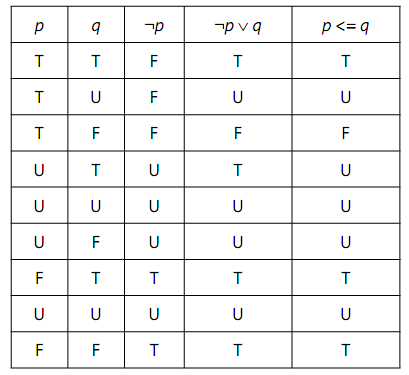
it is noted that in 2VL p → q is equivalent to ¬ p ∨ q. Study of Figure 3.5 reveals that ¬ p ∨ q does indeed equate to p → q when neither operand is unknown, and the same is true of p <= q! (It is the pronunciation, "is less than or equal to", rather than "implies", that led to my observation that SQL appears to include direct support for a 3VL form of implication by accident.)
1570_Conditionals - SQL.png

Figure: The SQL Truth Tables for ¬ p∨ q and p <= q

Note, however, that p <= q is not equivalent to ¬ p ∨ q. Intuitively, we understand that "p implies q" is true whenever q is true. This holds for ¬ p ∨ q but not for p <= q, as the row for p = U and q = T shows. The U in the last column for that row arises from SQL's general rule that whenever an operand of a comparison is NULL, the result is unknown-and NULL, when it is the result of evaluating a Boolean expression, is considered synonymous with unknown. In fact, Figure gives a demonstration of the fact that SQL is not always faithful to its own concept, that NULL represents "a value exists here but we don't know which value". What U really means when it appears in the column for p <= q is that <= is undefined for that particular pair of truth values.


Related Discussions:- Conditionals - sql

Declaring exceptions - user-defined exceptions, Declaring Exceptions T...

Declaring Exceptions The Exceptions can be declared only in the declarative part of the PL/SQL subprogram, block, or package. By introducing its name, you can declare an excep

Number types in pl/sql, Number Types The Number types permit you to sto...

Number Types The Number types permit you to store the numeric data (real numbers, integers, and floating-point numbers), show quantities, and do computations. BINARY_INTEG

Mixed notation, Mixed Notation The fourth procedure call shows that yo...

Mixed Notation The fourth procedure call shows that you can mix the positional and named notation. In this situation, the first parameter uses the positional notation, & the s

Sql outer join, SQL outer join SELECT * FROM IS_CALLED NATURAL LEFT...

SQL outer join SELECT * FROM IS_CALLED NATURAL LEFT JOIN IS_ENROLLED_ON Note that adding LEFT to an invocation of CROSS JOIN has no effect unless the right-hand operand

Benefit of the dynamic sql pl sql, Benefit of the dynamic SQL: This pa...

Benefit of the dynamic SQL: This part shows you how to take full benefit of the dynamic SQL and how to keep away from some of the common pitfalls. Passing the Names of Sc

Opening a cursor variable, Opening a Cursor Variable The OPEN-FOR stat...

Opening a Cursor Variable The OPEN-FOR statement relates a cursor variable with the multi-row query, executes the query, and then identifies the result set. The syntax for ope

Sql functions, SQL Functions The PL/SQL uses all the SQL functions invo...

SQL Functions The PL/SQL uses all the SQL functions involving the following aggregate functions that summarize the whole columns of the Oracle data: GROUPING, AVG, COUNT, STDDE

Cursor for loops, Cursor FOR Loops In most cases that need an explicit ...

Cursor FOR Loops In most cases that need an explicit cursor, you can simplify the coding by using a cursor FOR loop rather of the OPEN, FETCH, and CLOSE statements. A cursor FO

What is a record, What Is a Record  ? A record is a group of related...

What Is a Record  ? A record is a group of related data items that stored in the fields, each with its own name and datatype. Assume that you have different data about an em

Declaring subprograms, Declaring Subprograms   You can declare subprog...

Declaring Subprograms   You can declare subprograms in any PL/SQL subprogram, block, or package. But, you should declare subprograms at the end of the declarative part after a

Write Your Message!

Captcha
Free Assignment Quote

Assured A++ Grade

Get guaranteed satisfaction & time on delivery in every assignment order you paid with us! We ensure premium quality solution document along with free turntin report!

All rights reserved! Copyrights ©2019-2020 ExpertsMind IT Educational Pvt Ltd