Concept of permutation network, Computer Networking

Assignment Help:

Concept Of Permutation Network

In permutation interconnection networks the information replace requires data transfer from input set of nodes to output set of nodes and likely connections among edges are established  by  applying  a variety of  permutations  in  available  links.  There  are  a variety of networks where multiple paths from source to destination are feasible.  For finding out what the feasible routes in such networks are the learning of the permutation theory is a must.

Let us see,  the basic concepts of permutation with respect to interconnection network. Let us say the network has place of n input nodes and n output nodes.

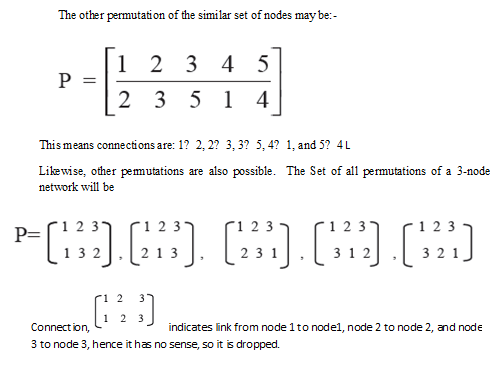
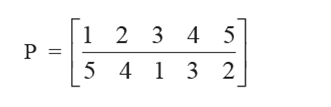
Permutation P for a network of 5 nodes (i.e., n = 5) is written as follows:
                                                             1110_Concept Of Permutation Network.png

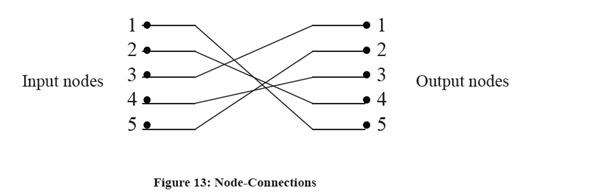
It means that node connections are 1↔5, 2↔ 4, 3↔1, 4↔3,  5↔2.

The connections are shown in the Figure .
                                   2184_Concept Of Permutation Network 1.png

                                     299_Concept Of Permutation Network 2.png

In these examples, only one set of links exist among input and output nodes and means it is a one stage network.  It may be possible that there exist many  links among input and output (i.e. multistage network).  Permutation of all these in a multistage network are known permutation group and these are represented by a cycle e.g. permutation

P= (1,2,3) (4,5) means the network has two sets of input and output nodes, one set consists of nodes 1,2,3 and another group exists of nodes 4,5 and connections are 1→2, 2→3, 3→1, and 4→5. Here set (1,2,3) has period 3 and (4,5) has period 2, collectively these sets has periodicity 3×2=6.

Interconnection  from all  the  feasible  input  nodes  to  all  the  output  nodes  figured  the permutation group.

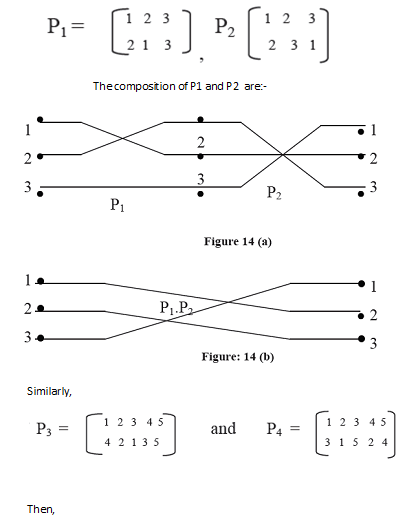
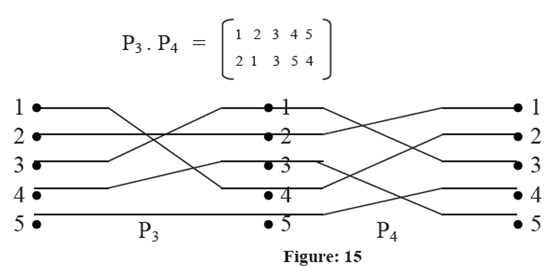
The permutations can be combined. This is called composition operation. In composition operation more than two permutations are applied in sequence, e.g. if P1 and P2 are two permutations defined as:
                                        1491_Concept Of Permutation Network 3.png

                                           1549_Concept Of Permutation Network 4.png

Composition of those permutations P1 P2 are characterized in Figures 14 (a) and 14 (b).There are some permutations of special significance in interconnection network.  These permutations are given by hardware. Now, let us talk about these permutations in detail.


Related Discussions:- Concept of permutation network

Flash updates, IGRP uses flash updates, poison reverse updates, hold down t...

IGRP uses flash updates, poison reverse updates, hold down times, and divide horizon. How often does it broadcast its routing table updates? Ans) 90 seconds

Explain asynchronous FDDI, Explain Asynchronous FDDI Asynchronous bandw...

Explain Asynchronous FDDI Asynchronous bandwidth is allocated utilizing an eight-level priority scheme. Every station is assigned an asynchronous priority level. FDDI as wel

Parts count method, PARTS COUNT METHOD This prediction method is appli...

PARTS COUNT METHOD This prediction method is applicable at preliminary stages, during bid proposal and early design phases; when insufficient information is available regardin

Relevance and protection regarding dns attacks, Relevance and Protection re...

Relevance and Protection regarding DNS Attacks While discussing about the relevance and protection of the database, there are many things which need to consider. Almost, may o

Chord, how to implement chord connection as the network management system ?...

how to implement chord connection as the network management system ?

Network interface hardware, NETWORK INTERFACE HARDWARE:  CPU can't ope...

NETWORK INTERFACE HARDWARE:  CPU can't operate data at network speeds. So in order to connect to the network device systems use special purpose hardware for network connection

Differentiate between rarp and arp, TCP/IP Protocol Suite 1. What is th...

TCP/IP Protocol Suite 1. What is the concept of Multi-protocol encapsulation in ATM networks? 2. Differentiate between RARP and ARP. 3. Differentiate TDP and UDP. 4. D

Explain 10base2 - thinnet, 10Base2 - Thinnet Cable diameter is abou...

10Base2 - Thinnet Cable diameter is about 0.64 cm (RG-58) More flexible as well as easier to handle and install than Thicknet "2" represents a maximum segment len

Explain inference, What is inference? Ans) The principle of "inference"...

What is inference? Ans) The principle of "inference" is fairly a simple one: being capable to derive new data from data that you already know. In a mathematical sense, querying

Write Your Message!

Captcha
Free Assignment Quote

Assured A++ Grade

Get guaranteed satisfaction & time on delivery in every assignment order you paid with us! We ensure premium quality solution document along with free turntin report!

All rights reserved! Copyrights ©2019-2020 ExpertsMind IT Educational Pvt Ltd