Concept of data transmission, Computer Networking

Assignment Help:

Overview of Data transmission network model

A network is a combination of hardware and software that sends data from one location to another. The hardware consists of the physical equipment that carries signals from one point of the network to another. The software consists of instruction sets that make possible the services that we expect from a network.

 When sending data from software to actual physical transmission link (medium), there are several layers. Each layer provides certain services. The Open System Interconnection (OSI) layer model is the international standard, and it has 7 layers.
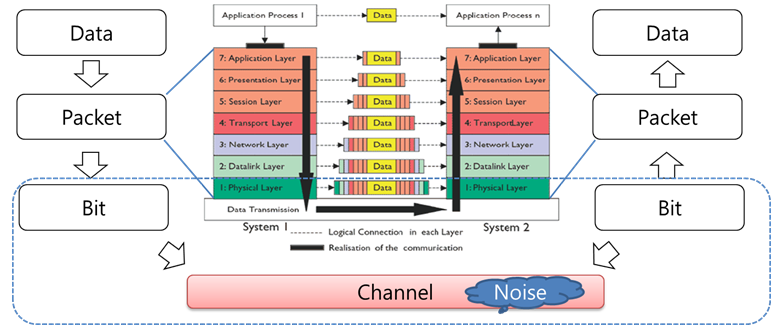
914_Concept of data transmission.png

Fig. General digital control system

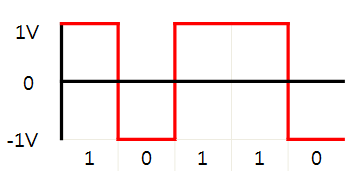
When the digital data is transmitted through real line, these digital data should be converted to either a digital signal or an analog signal. In this project, we will convert a data to a digital signal. There are several conversion methods, and we use one of the simple methods as below.
1918_Concept of data transmission1.png

Fig. Example of signal conversion from digital data

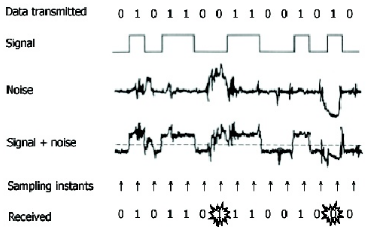
 The waveform pattern of 1V or -1V used to represent the 1s and 0s of a digital data on a transmission channel. Suppose the transmission link is not ideal, some noises can be added to original signal. If the amplitude of the noise follows the normal distribution, the noise is called Gaussian noise.


375_Concept of data transmission2.png

Fig. 3. Data transmission on noise channel

 The function that generates 'Gaussian noise' will be given, and the argument of the function is SNR (Signal-to-noise ratio) dB(decibel). SNR is defined as the ratio of signal power to the noise power, and SNRdB is defined as 10*Log(SNR). Large SNR means that signal power is relatively higher than noise power, so noise is less effective. If noise is less effective, received data has less error.

Even though sending the data on the channel whose SNR is identical, reliable communication is possible when using error-detecting code or error-correcting code.


Related Discussions:- Concept of data transmission

Describe network topology and vpn, Describe Network Topology and VPN Ne...

Describe Network Topology and VPN Network Topology refers to the layout of a computer network. It presents how devices and cables are physically laid out, as well as how they j

Describe random forests, Random forests : An ensemble of the classification...

Random forests : An ensemble of the classification or the regression trees (see the classification and regression tree methods) that have been fitted to the same n observations, bu

Verify network connectivity- ccna, Verify Network Connectivity Step 1: ...

Verify Network Connectivity Step 1: Use the ping command to determine network connectivity. You can determine network connectivity using the ping command.  Note: If pings

Permanent virtual circuits, ATM can give customers with virtual circuits th...

ATM can give customers with virtual circuits that seem traditional leased digital circuits. Such permanent virtual circuits (PVC) fixed as the customer pay the periodic fee for its

Determine the subnet with subnet prefix, Consider a subnet with subnet pref...

Consider a subnet with subnet prefix 101.101.101/24  a)  If you subdivide the subnet into four equal size subnets, what are their prefixes? Give all four prefixes in the form a.

Firewall architectures-dual homed host architecture, Dual Homed Host Archit...

Dual Homed Host Architecture This setup consists of a host machine with two or more IP addresses for each of its physical port. One port is connected to intranet and other to the

Wireless Networks, Is a complete OSI/TCPIP network architecture available i...

Is a complete OSI/TCPIP network architecture available in MATLAB?

Explain the 802.11 fhss, 802.11 FHSS Frequency-hopping spread spectrum ...

802.11 FHSS Frequency-hopping spread spectrum in a 2.4 GHz band Carrier sends on one frequency for short duration then hops to another frequency for same duration, hops agai

Describe a typical dns system, Question: (a) With the help of a diagra...

Question: (a) With the help of a diagram, describe a typical DNS system. (b) Using signal sequence or state transition diagrams, illustrate the following scenarios: i.

Write Your Message!

Captcha
Free Assignment Quote

Assured A++ Grade

Get guaranteed satisfaction & time on delivery in every assignment order you paid with us! We ensure premium quality solution document along with free turntin report!

All rights reserved! Copyrights ©2019-2020 ExpertsMind IT Educational Pvt Ltd