Classify the magnetic materials, Electrical Engineering

Assignment Help:

Classify the magnetic materials into diamagnetic, paramagnetic, ferromagnetic and ferrimagnetic materials. Also give examples of each.

Classification of magnetic materials:-

Magnetic materials for that linear relationship in between M and H exists are divided in classes depending on the sign of χ (magnetic susceptibility). Materials that have negative value of χ the order of 10-4 to 10-6 are termed as diamagnetic and those that have a positive value of χ of about similar order of magnitude are termed as paramagnetic. When the relationship in between M and H is non-linear and shows hysterises effect, this group of materials wherein the resultant magnetization is one to some orders of magnitude. Such materials are called Ferromagnetic materials.

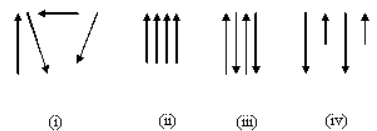
The other classification of magnetic materials contains in the presence or absences of permanent magnetic dipolar in them, Materials, that lack permanent magnetic dipoles, are termed as diamagnetic. When permanent magnetic dipoles are present in the atoms of a material, this may be ferromagnetic, paramagnetic, anti- ferromagnetic of ferrimagnetic depending upon the interaction among the individual dipoles. Therefore, if the interact between the atomic permanent dipoles moments is negligible or zero and the individual dipole moments are oriented at random as demonstrated in figure (i).
1547_magnetic materials.png

That material will be paramagnetic. If the dipole interacts in which a manner which they tend to line up in parallel, as demonstrated in figure (ii), the material will be ferromagnetic. If neighbouring moments are aligned anti parallel as demonstrated in figure (iii), the materials are anti- ferromagnetic. There is a large resultant magnetization, in ferromagnetic materials whereas in anti- ferromagnetic materials the magnetisation vanishes. While the order of the magnetic moments is as demonstrated in figure (iv), the phenomena is termed as ferrimagnetisms.

Illustrations of diamagnetic materials are Diamonds, copper and Graphite. Illustrations of paramagnetic materials are Ebonite and platinum and also Aluminium. Illustrations of Ferromagnetic materials are cobalt, Nickel and Iron.


Related Discussions:- Classify the magnetic materials

Applications of holography, Applications of holography 1.       Hologra...

Applications of holography 1.       Holography is used in the non-destructive tests by interferometic methods. In this method called double exposure holographic interferometry,

Water.., hot and cold lime soda process

hot and cold lime soda process

DC machines, what are the functions of interpolar winding and compensating ...

what are the functions of interpolar winding and compensating winding?

What is a co-processor, What is a co-processor? 8087 NDP (numerical da...

What is a co-processor? 8087 NDP (numerical data processor) is also termed as math co-processor that is used in parallel with the major processor for number crunching applicat

Determine the power flow diagram for a dc generator, a. Determine the power...

a. Determine the power flow diagram for a DC generator. b. A shunt wound DC generator delivers 496 A at 440 V to a load. The resistance of  the shunt field coil is 110? and that

Explain indexed addressing in 8051, Probelm: (a) Explain indexed addre...

Probelm: (a) Explain indexed addressing in 8051. (b) How does the 8051 distinguish between a byte address and a bit address? (c) How do open-loop and closed loop appli

Mutual inductance and coefficient of coupling, Mutual inductance and coeffi...

Mutual inductance and coefficient of coupling: The equivalent inductance of two series connected coil (with mutual inductance among them) is 0.8 or 0.2 Henry based on the rela

What do you mean by digital building blocks, Q. What do you mean by Digital...

Q. What do you mean by Digital Building Blocks? Whereas a continuous change from one value to another is the essential characteristic of an analog signal and continuous-state (

Principle of three-phase synchronous machines, Q. Principle of Three-phase ...

Q. Principle of Three-phase synchronous machines? In fact, with very few exceptions, three-phase synchronous machines are most commonly used for power generation. In general, t

Write Your Message!

Captcha
Free Assignment Quote

Assured A++ Grade

Get guaranteed satisfaction & time on delivery in every assignment order you paid with us! We ensure premium quality solution document along with free turntin report!

All rights reserved! Copyrights ©2019-2020 ExpertsMind IT Educational Pvt Ltd