Chemistry of living matter, Biology

Assignment Help:

Chemistry of Living Matter
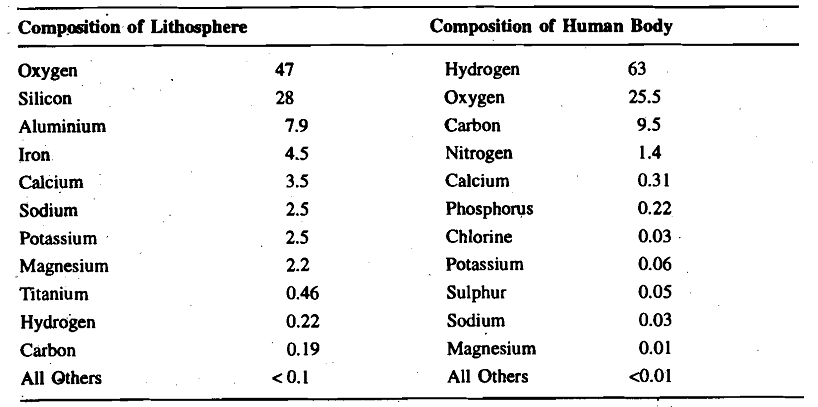
All living things including ourselves, are made of protoplasm. Protoplasm is essentiallya colloidal suspension of proteins in a w&ery solution. It is composed of molecules, the main element being carbon, which occurs in association with hydrogen, nitrogen and oxygen. Other elements like phosphorus, calcium, sodium etc. occur in small quantities. Table.

Table: Composition of elements in the earth's crust (the lithosphere) and the human body. Each number represents the percent of the total number of atoms present; for example 47 of every 100 atoms found in a representative sample of the earth's crust are oxygen atoms. Whereas there are only 19 atoms of carbon in every 10,000 atoms of the earth's crust. The four most abundant elements in the earth's crust are oxygen, silicon, aluminium and iron. While the four most abundant elements in Living organism are hydrogen, oxygen, carbon and nitrogen. So except for oxygen, in living organism, ,silicon, aluminium and iron occur only in traces. About 75% of the body of most animals is composed of water and 50% of the remaining dry weight is carbon with little if any silicon. The earth's crust in contrast, consists of 28% silicon and less than 0.1% carbon.
2427_Chemistry of Living Matter.png

This table compares the relative abundance of the most prevalent elements in the earth's crust with those in our body. As you can see from the table, living matter makes use of only very few of the elements available to it. Furthermore, the relative proportion of elements found in living organisms is different from that found in the environment. In other words, living matter can take up certain elements that are scarce in the nonliving environment and concentrate them within living cells.

Moreover, there is a rapid turnover of material in living things. For example, carbon is taken up in the form of sugar, and is given out in the form of carbon dioxide. You do not see the same carbon atom in an organism bemanently. Thus the organisation of atoms and molecules in living systems is more dynamic than in nonliving objects, such as rock. The rock we see today contains the same atoms it had last year. By contrast the rabbit we see today is largely composed of atoms acquired since we saw it last year.The carbon based compounds produced by living organisms can be divided broadly into carbohydrates, fats and proteins. These then get organized into structures - called cells which form the basic units involved in the specific organization of organisms.


Related Discussions:- Chemistry of living matter

Symptoms of serum sickness, Symptoms contain fever, weakness, rashes, with ...

Symptoms contain fever, weakness, rashes, with erythema and edema. Serum sickness depends on the immune difficult formed and the size of the complexes.

What is the usual biological function of connective tissues, Q. What is the...

Q. What is the usual biological function of the connective tissues? How is this function associated to the main features of its cells? The usual function of the connective tiss

The cell body of the toe motor neuron, Which of the following is true for a...

Which of the following is true for a toe motor neuron that excites a toe muscle that moves the big toe in the left foot? A. All of the axon terminals of the toe motor neuron ar

Microorganisms, what are four types of microorganisms and their definitions...

what are four types of microorganisms and their definitions?

Explain why this drug would eventualy kill a person, Dinitrophenol, DNP, wa...

Dinitrophenol, DNP, was prescribed in low doses in the 1940's to help obese patients lose weight. It's use for this purpose was discontinued when several users died. DNP makes the

Explain terms retrogradation and gelatinization, What do you understand by ...

What do you understand by the terms retrogradation and gelatinization? The realignment of the amylose and amylopectin and swollen starch granules to form a pocket is termed

What are the plant root hairs, What are the plant root hairs? Where can the...

What are the plant root hairs? Where can they be found and what is their function? The root hairs are external elongated projections of the root epidermis. Their role is to

Horse diseases-japanese encephalitis, Japanese encephalitis The Japane...

Japanese encephalitis The Japanese encephalitis is a mosquito-born flavivirus infection that causes encephalitis in human and equines and abortion in pigs, caused by Japanese

How to obtain the absorbance of a stationary culture, If a spectrophotomete...

If a spectrophotometer can read accurately within the range of 0.1-1.0 optical density units, then how can you obtain the absorbance of a stationary culture (which may have an A550

Write Your Message!

Captcha
Free Assignment Quote

Assured A++ Grade

Get guaranteed satisfaction & time on delivery in every assignment order you paid with us! We ensure premium quality solution document along with free turntin report!

All rights reserved! Copyrights ©2019-2020 ExpertsMind IT Educational Pvt Ltd