Calculate the total latency, Computer Network Security

Assignment Help:

Question

(a) Inspect the following ifconfig output of an IPv6 interface:

1903_Calculate the total latency1.png

i. What is the hidden Hardware Address of the interface on Line #1?
ii. What is the hidden subnet mask on Line #2?
iii. What does /10 mean on line #3?
iv. Why does line #4 have /64?

(b) Consider that a host is sending a frame of 1500 bytes to another host found 10 kilometers away. determine the total latency (from the first bit transmitted by sending host to the last bit buffered by receiving host) on a 100 Base-FX Ethernet network with a "store-N-forward" switch in the path. Consider that the speed of light in a fiber-optic cable is 2 x 10⁸ms-1and that the switch begins retransmitting immediately (i.e. switching delay is negligible) after it has finished buffering the frame completely.

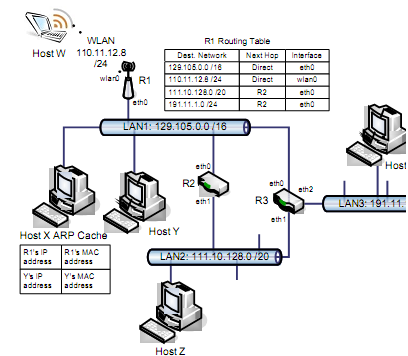
(c) Please refer to the Figure below and answer the following:

i. Consider Host X intend to transfer an IP datagram to Host Y, which is on the same LAN: LAN1 with network id 129.105.0.0 /16. Briefly explain the different interactions that take place by Host X at both the network layer and data-link layers for sending this datagram to Host Y. (The ARP cache of host X at that moment is shown above.)

ii. Suppose now that Host X wants to send a datagram to Host W, which is connected to an 802.11g router R1 via a wireless LAN (network id for this WLAN is 110.11.12.8 /24). Should Host X use ARP to query for Host W's MAC address?

iii. Suppose that router R1 is the default gateway for Host X, briefly describe the steps taken by Host X and R1 at both the network layer and data-link layer for sending a datagram to host W. (The routing table of R1 is shown above. Assume R1 has the MAC address of W in its ARP cache.)

iv. Host X now wants to send a datagram to Host Z on LAN 2 (network id: 111.10.128.0 /20). Assume that Host X has default gateway as R1. Describe the actions taken by R1 (and hence at R2) at both the network layer and data-link layer for routing this datagram to host Z.

v. Consider Host X intends to send another datagram to Host Z. Will Host X still send it to R1? Or will it send it to R2? Since Host X does not have R2's MAC address. Explian how Host X obtains R2's MAC address using the ARP protocol.
2229_Calculate the total latency.png


Related Discussions:- Calculate the total latency

Point-to-point topology, POINT-TO-POINT: In Point-to-Point topology th...

POINT-TO-POINT: In Point-to-Point topology there are two kind of topologies. 1) STAR topology 2) TREE topology In star topology each and every computer is connect

Draw the waveform for an asynchronous transmission, Question: (a) Draw...

Question: (a) Draw the waveform for an asynchronous transmission with the following specifications: Character "H", one even parity bit, one start bit, one stop bit, and a b

Kasonet pinging system, KASONet Pinging System: Project Title:       ...

KASONet Pinging System: Project Title:                                                           "KASONet Pinging System"   Brief Overview of Project: The o

Collision, COLLISION: The receiver can get simultaneous requests, which gi...

COLLISION: The receiver can get simultaneous requests, which gives in collision at receivers and both service lost and in this way no transmitter accepts reservations and both use

Problem of spam mail, Topic -Spam is an ever-growing problem, with some net...

Topic -Spam is an ever-growing problem, with some network administrators reporting that 90% or moreof the email delivered to their mail servers is spam. Identify and briefly evalua

Describe how lower bounds on arc flows, QUESTION: (a) Suppose the graph ...

QUESTION: (a) Suppose the graph below, use the Flow Decomposition method to list the cycles and paths produced. (b) Describe how Lower Bounds on Arc Flows are eliminated

Routing table, ROUTING TABLE For efficiency, information about forward...

ROUTING TABLE For efficiency, information about forwarding is saved in a routing table, which is started at system initialization and must be updated as network topology modif

What are the intermediate systems and how they work, Question: a) Expla...

Question: a) Explain what the following intermediate systems are and how they work? i. Repeater ii. Bridge b) A service is formally specified by a set of primitives (op

Securities Issues in a company, 'Near Field Communication' (NFC) technologi...

'Near Field Communication' (NFC) technologies are expected to become commonplace in the near future. Some relevant features are these: A suitable device (such as a mobile pho

Write Your Message!

Captcha
Free Assignment Quote

Assured A++ Grade

Get guaranteed satisfaction & time on delivery in every assignment order you paid with us! We ensure premium quality solution document along with free turntin report!

All rights reserved! Copyrights ©2019-2020 ExpertsMind IT Educational Pvt Ltd