Buses, Basic Computer Science

Assignment Help:

BUSES

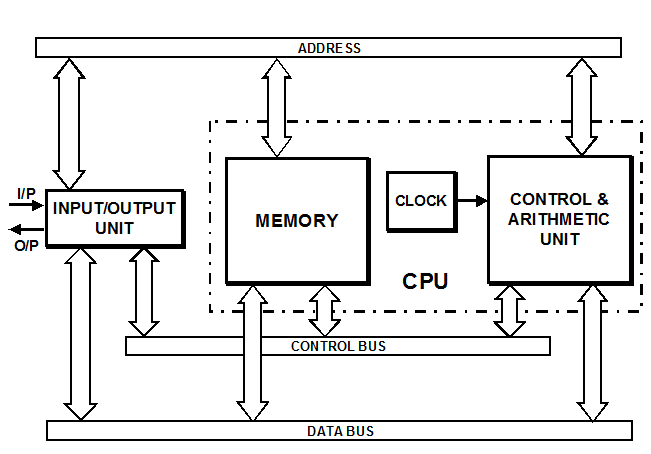
It can be seen from Figure 4 that there are three buses - the data bus, the address bus, and the control bus. Each bus consists of a group of parallel wires.

The data bus transfers data between memory, CPU and I/O units, under the control of signals sent through the control bus. For example, if data is to be transferred (sent) from the CPU to a memory location, the control unit within the CPU places an output instruction on the CPU, and write instruction on the memory unit. When the data arrives at the memory, it must be written into the memory at a given address. The address is already present, having been sent by the CPU along the address bus. Hence, data is stored at the memory address given. Note that if the transfer had been from the CPU to an I/O device, the address of the I/O device would have been given.

The address bus is one-way only. The control bus usually has one set of wires for input sensing lines, and one set for output controls.

Data buses are usually bi-directional; that is, data is either transferred, or fetched along the same set of wires. The control unit usually decides in which direction data will travel. If there are several peripherals, and these all wish to use the CPU at the same time, some method of priority must be established. There are various ways of achieving this. One method uses the control unit to select the lucky peripheral, whilst another method lets the peripherals themselves automatically decide which peripheral takes control.
1232_buses.png


Related Discussions:- Buses

Write the steps to use the network setup wizard, Problem Write the step...

Problem Write the steps to use the Network setup wizard. Elaborate the optional subcomponents in the windows component wizard. 1. Click Next to skip past the Welcome screen.

Wide area networks and metropolitan area networks, Metropolitan Area Networ...

Metropolitan Area Networks : These type of networks generally cover specific metropolitan area and provide to them all the services.  Wide Area Networks (WANs): Wide Are

Cai, What is CAI? Explain its pitfalls.

What is CAI? Explain its pitfalls.

Data transmission, DATA TRANSMISSION: When we talk on the telephone we...

DATA TRANSMISSION: When we talk on the telephone we generally transmit a message to someone else. The message is made up of words that we speak into the telephone instrument.

Generic techniques in artificial intelligence, G e ne ric Techniques Dev...

G e ne ric Techniques Developed: In  the  pursuit  of  solutions  to  many   problems  in  the  above  categories,  serval specific  techniques have sprung up which have bee

Output design, Discuss the factors considered during output design

Discuss the factors considered during output design

Networking and telecommunications, NETWORKING AND TELECOMMUNICATIONS: ...

NETWORKING AND TELECOMMUNICATIONS: Computers can now communicate with each other and with a range of peripheral devices, over distances with increasing speed and reliability.

Indexing and abstracting databases, Indexing and Abstracting Databases: ...

Indexing and Abstracting Databases: A study of growth of indexing and abstracting services over the years would show that during the past two centuries, these services have be

Explain the terms sampling and aliasing, QUESTION (a) Consider a syste...

QUESTION (a) Consider a system with input x[n] and output y[n] that satisfy the difference equation:                                   Y[n] = x[n] + 0.5 x[n-2] + 0.2 x[n+1]

Write Your Message!

Captcha
Free Assignment Quote

Assured A++ Grade

Get guaranteed satisfaction & time on delivery in every assignment order you paid with us! We ensure premium quality solution document along with free turntin report!

All rights reserved! Copyrights ©2019-2020 ExpertsMind IT Educational Pvt Ltd