Basics of vectors - calculus, Mathematics

Assignment Help:

Vectors - The Basics

Let us start this section off with a quick discussion on what is the use of vector.  Vectors are utilized to present quantities that have both a magnitude and a direction.  Good instances of quantities that can be presented by vectors are force and velocity.  Both of these consist of a direction and a magnitude.  

 Let us consider force for a second.  A force of like 5 Newtons that is applied in a specific direction can be applied at any point in space.  Alternatively, the point where we apply the force does not alter the force itself.  Forces are not dependent of the point of application.  To describe a force all we need to know is the magnitude of the force and the direction which the force is applied in.

 Similar idea holds more usually with vectors.  Vectors just only impart magnitude and direction. 

They don't impart any type of information about where the quantity is applied.  This is an significant idea to all time remember in the study of vectors.

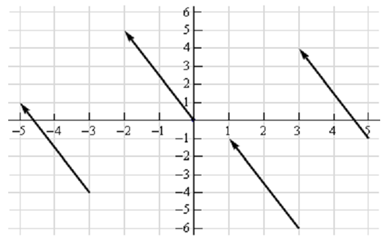
Graphically vectors are presented by directed line segments.  The direction of the line segment is the direction of the vector and length of the line segment is the magnitude of the vector.  Though, because vectors don't impart any information about where the quantity is applied any directed line segment along with similar length and direction will represent similar vector.

Consider the sketch below.  
1945_Basics of Vectors - Calculus 1.png

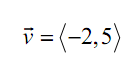
Every directed line segments in the sketch represents similar vector.  In each case the vector starts at a particular point after that moves 2 units to the left and 5 units up. The notation that we'll make use for this vector is,
1137_Basics of Vectors - Calculus 2.png

and each directed line segments in the diagram are called representations of the vector.


Related Discussions:- Basics of vectors - calculus

Newtons method , Newton's Method : If x n is an approximation a solution ...

Newton's Method : If x n is an approximation a solution of f ( x ) = 0 and if given by, f ′ ( x n ) ≠ 0 the next approximation is given by

Arc length formula - applications of integrals, Arc length Formula L = ...

Arc length Formula L = ∫ ds Where ds √ (1+ (dy/dx) 2 ) dx                                     if y = f(x), a x b ds √ (1+ (dx/dy) 2 ) dy

Applications of de moiver, what are the applications of de moiver''s theore...

what are the applications of de moiver''s theorem in programming and software engineering

Interval of validity, The interval of validity for an IVP along with initia...

The interval of validity for an IVP along with initial conditions: y(t 0 ) = y 0 or/and y (k) (t 0 ) = y k There is the largest possible interval on that the solution is va

Auxiliary methods for information distribution, AUXILIARY METHODS There...

AUXILIARY METHODS There are other reprographic methods which although commonly used earlier, are now mainly used for specific purposes. We think you should be aware of these me

Whats this, how do you determine if a graph has direct variation

how do you determine if a graph has direct variation

What distances from the two gates should the pole, A pole has to be erected...

A pole has to be erected at a point on the boundary of a circular park of diameter 13m in such a way that the differences of its distances from two diametrically opposite fixed gat

#title., Julia must do a 70:30 split of all of her profits with the Departm...

Julia must do a 70:30 split of all of her profits with the Department of Athletics. Julia also has the ability to sell soft drinks. If she decide to sell soft drinks, she must agre

Write Your Message!

Captcha
Free Assignment Quote

Assured A++ Grade

Get guaranteed satisfaction & time on delivery in every assignment order you paid with us! We ensure premium quality solution document along with free turntin report!

All rights reserved! Copyrights ©2019-2020 ExpertsMind IT Educational Pvt Ltd