Basic assumption of transportation model, Managerial Accounting

Assignment Help:

Basic Assumption of Transportation Model

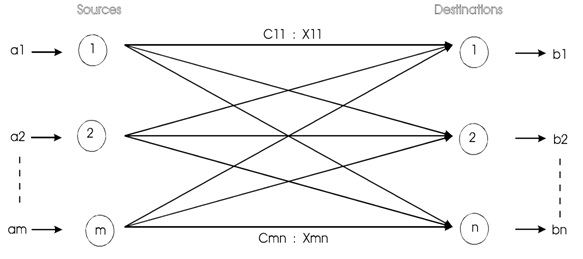
The basic assumption of the model is that the transportation cost on a given route is directly proportional to the number of units transported. The "unit of transportation" will differ based on the "commodity" transported i.e. a truck load may be a better unit than single product units.
559_diagram1.jpg


m = Source
n = Destination

A source or destination is represented by a node. The line joining a source with a destination represents the route through which the commodity is transported.
The quantity of supply at source i is ai and the demand at destination j is bj. The "unit" transportation cost between source i and destination j is cij

Let xij represent the amount transported from i to destination j.

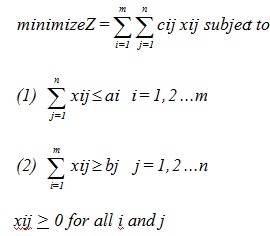
The LP Model symbolizing the transportation problem is given usually as:
1127_diagram2.jpg

     
 xij > 0 for all i and j

(1)   It stipulates that the sum of the shipments from a source cannot exceed its supply.
(2)   It requires that the sum of the shipments to a destination must satisfy its demand.

529_diagram3.jpg

The model explained above implies that the total supply


must at least equal the total demand if the total supply equal the total demand then it is called a balanced transportation model.  It differs from the above model in the fact that all constraints are equations.

1529_diagram5.jpg


In actual life, this is not essentially true. Though, a transportation model can always be balanced. The balancing, in addition to its usefulness in modeling certain practical situations is important for the development of a solution method that fully exploits the special structure of the transportation model.


Related Discussions:- Basic assumption of transportation model

Calculate the net increase or decrease in monthly profit, Painter Ltd, whic...

Painter Ltd, which manufactures and sells a single product, is currently producing and selling 102,000 units per month, which represents 85% of its full capacity. Total monthly cos

Process of pricing in maturity period, Q.Process of Pricing in maturity per...

Q.Process of Pricing in maturity period? Maturing periods is the third stage in the life cycle of a product. If is a stage between growth period and decline period of sales. So

Journal Entries and T-account, h. Production orders that had cost 450,000 t...

h. Production orders that had cost 450,000 to complete according to their job cost sheets were shipped to customers during the month. These goods were sold on account at 50% above

Cross elasticity of demand, what is cross elasticity of demand? is it posit...

what is cross elasticity of demand? is it positive for substitute or compliments? show in a diagram relating to the demand for the coffee to the price of tea

State the penetration pricing, State the Penetration pricing As opposed...

State the Penetration pricing As opposed to the skimming pricing the objective of penetration pricing is to gain a foothold in a highly competitive market. The objective of thi

Linear Programming, Definition of Linear Programming What is Linear Program...

Definition of Linear Programming What is Linear Programming

Cost analysis purposes, Cost Analysis purposes For purposes of cost ana...

Cost Analysis purposes For purposes of cost analysis, the desegregation of the generic value chain into individual value activities should reflect three principles that are not

Explain the interest coverage ratio, Interest coverage ratio (or debt servi...

Interest coverage ratio (or debt service ratio)  Meaning: this ratio establishes a relationship among net profits before interest and taxes and interest on long debt. Obj

Write Your Message!

Captcha
Free Assignment Quote

Assured A++ Grade

Get guaranteed satisfaction & time on delivery in every assignment order you paid with us! We ensure premium quality solution document along with free turntin report!

All rights reserved! Copyrights ©2019-2020 ExpertsMind IT Educational Pvt Ltd