Apply depth-first-search to find out the spanning tree, Mathematics

Assignment Help:

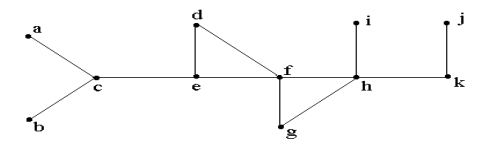
Apply depth-first-search to find out the spanning tree for the subsequent graph with vertex d as the starting vertex.       
1410_Apply depth-first-search to find out the spanning tree.png

Ans: Let us begin with node'd'. Mark d as visited node. Node'd' comprises two child 'e' and 'f'. After that Visit node 'e' and mark it as visited. Select edge (d, e) and add it to spanning tree T. So, T = {(d, e)}  Now e has e has two children: c and f. Visit c, add (e, c) to T, and mark c as visited. After that visit a and after that b. Mark them visited node and add arcs (c, a) and (c, b) to T. Up to here 

T = {(d, e), (e, c), (c, a), (c, b)}

Now here c has one more child e, which is previously visited, so exit recursion and go up to e that one more unvisited child f. Visit it, mark it as visited and we add (e, f) to T.  f comprise three (3) children: d, g and h. d is visited so leave it. Visit g, and doing the basic work of marking as visited and adding the arc utilized to visit the node in T, we at last get T as 

T = {(d, e), (e, c), (c, a), (c, b), (e, f), (f, g), (g, h), (h, i), (h, k), (k, j)}


Related Discussions:- Apply depth-first-search to find out the spanning tree

History of Mathematics, What are the key features of Greek Mathematics? How...

What are the key features of Greek Mathematics? How does the emphasis on proof affect the development of Greek Mathematics?

Calculate zeros in the denominator of rational expressions, About Zeros in ...

About Zeros in the Denominator of Rational Expressions One thing that you must be careful about when working with rational expressions is that the denominator can never be zero

Transpose of a matrix, I didn't understand the concept of Transpose of a Ma...

I didn't understand the concept of Transpose of a Matrix, need assistance.

Differential equation (dy/dx) +x^2 = x^2*e^(3y), The general solution of th...

The general solution of the differential equation (dy/dx) +x^2 = x^2*e^(3y). Solution)(dy/dx) +x^2 = x^2*e^(3y) dy/dx=x 2 (e 3y -1) x 2 dx=dy/(e 3y -1) this is an elementar

What is uniform distribution, Q. What is Uniform Distribution? Ans. ...

Q. What is Uniform Distribution? Ans. A distribution is the set of possible values of a random variable considered in terms of their theoretical or observed frequency. Th

Root of function, Root of function: All throughout a calculus course we wi...

Root of function: All throughout a calculus course we will be determining roots of functions.  A root of function is number for which the function is zero.  In other terms, determ

Write Your Message!

Captcha
Free Assignment Quote

Assured A++ Grade

Get guaranteed satisfaction & time on delivery in every assignment order you paid with us! We ensure premium quality solution document along with free turntin report!

All rights reserved! Copyrights ©2019-2020 ExpertsMind IT Educational Pvt Ltd