3-d coordinate system - three dimensional spaces, Mathematics

Assignment Help:

The 3-D Coordinate System

We will start the chapter off with a quite brief discussion introducing the 3-D coordinate system and the conventions that we will be utilizing.  We will as well take a concise look at how the different coordinate systems can alter the graph of an equation.

 Let us first get some basic notation out of the way.  The 3-D coordinate system is frequently denoted by R3.  Similarly the 2-D coordinate system is frequently denoted by R2 and the 1-D coordinate system is represented by Rn.  As well, as you might have guessed then a general n dimensional coordinate system is frequently denoted by Rn.

 Subsequently, let's take a quick look at the basic coordinate system.
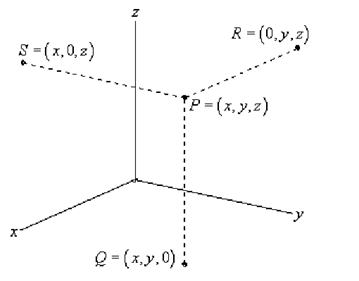
786_3-D Coordinate System - Three dimensional spaces.png

The above is the standard placement of the axes in this class.  It is supposed that only the positive directions are displayed by the axes.  If we require the negative axes for any reason we will put them in as required. 

As well note the various points on this sketch.  The point P is the common point sitting out in 3-D space.  If we begin at P and drop straight down until we arrive a z-coordinate of zero we arrive at the point Q.  We state that Q sits in the xy-plane.  The xy-plane refers to all the points that have a zero z-coordinate.  We can as well start at P and move in the other two directions as displayed to get points in the xz-plane (this is S along with a y-coordinate of zero) and the yz-plane (this is R along with an x-coordinate of zero).   

Jointly, the xy, xz, and yz-planes are occasionally termed as the coordinate planes. 

As well, the point Q is often considered to as the projection of P in the xy-plane.  Similarly, R is the projection of P in the yz-plane and S is the projection of P in the xz-plane. 

Several formulas that you are employed to working with in R2 have natural extensions in R3.


Related Discussions:- 3-d coordinate system - three dimensional spaces

Repetition need not be boring-ways to aid learning maths, Repetition Need N...

Repetition Need Not Be Boring :  From an early age on, children engage in and learn from repetitive behaviour, such as dropping and picking up things, opening and closing boxes an

Karls pearsons co-efficient of correlation, Aim: To test the significan...

Aim: To test the significant relationship between the accounting ratios of operating management and standard ideal ratios. Null Hypothesis(H 0 ) : There is no significa

What is the probability that the card is a queen, Five cards - the ten, jac...

Five cards - the ten, jack, queen, king and ace, are well shuffled with their face downwards. One card is then picked up at random. (i)  What is the probability that the card is

Área de un rectangulo, calcula el área de la región sombreada de un rectáng...

calcula el área de la región sombreada de un rectángulo cuya base es 12.6 cm y su altura es 8.4

Define an ordered rooted tree, Define an ordered rooted tree. Cite any two ...

Define an ordered rooted tree. Cite any two applications of the tree structure, also illustrate using an example each the purpose of the usage.   Ans: A  tree is a graph like t

What is the median of her scores, Jody's English quiz scores are 56, 93, 72...

Jody's English quiz scores are 56, 93, 72, 89, and 87. What is the median of her scores? To find out the median, first put the numbers in sequence from least to greatest. 56, 7

Proof of the derivative of a constant, Proof of the Derivative of a Constan...

Proof of the Derivative of a Constant : d(c)/dx = 0 It is very easy to prove by using the definition of the derivative therefore define, f(x) = c and the utilize the definiti

Write Your Message!

Captcha
Free Assignment Quote

Assured A++ Grade

Get guaranteed satisfaction & time on delivery in every assignment order you paid with us! We ensure premium quality solution document along with free turntin report!

All rights reserved! Copyrights ©2019-2020 ExpertsMind IT Educational Pvt Ltd