Reference no: EM132519706
Question 1. How can you distinguish between bacteria and eukaryotes?
Question 2. Which bacterial morphology or morphologies can you identify in the image below?
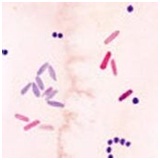
Question 3. a. Your 10 year-old cousin's friend told your little cousin that they are covered in bacteria, and therefore, your cousin is gross. What would you say to your cousin to convince them that being covered in bacteria is not abnormal or gross? Please explain in 2-3 sentences, and remember that your cousin is in 5th grade.
b. Your cousin then asks if there are bacteria everywhere in/on the body. How would you answer the question in 1 sentence?
c. Your aunt overhears you talking to your cousin and asks where most of the bacteria are in/on the body, and if those bacteria are helpful or harmful. Identify a particular location, and then answer your aunt's question in 2-3 sentences.
d. Next, your aunt asks if there are ways to change the microbiota. Name at least 2 ways to change the microbiota.
e. Your other cousin, a high school student, chimes in. They heard that bacteria and viruses are basically the same thing from their friend. Identify at least 2 ways that bacteria are different from viruses.
Question 4. One of your classmates mentioned on the discussion board that germ-free and gnotobiotic mice can be used interchangeably. Is this true? If yes, explain the methods used to generate each kind of mouse, and if not, explain how they are different.
Question 5. a. A research paper uses the steps of Koch's Postulates to draw connections between a particular organism and an infection in parakeets. Would this be a correlative or a causative study? Explain your reasoning.
b. If the authors of the study listed above wanted to expand their work to include humans, what mechanism is used to ensure that their study is ethical? Explain your answer in 2 sentences.
c. Is the paper that used Koch's Postulates a primary article or a secondary article? Support your answer in 1 sentence, and then explain what would be needed for the other kind of article.
Question 6. a. Identify the kinds of information you would expect to find in the Abstract of a scientific paper and the format that would be used to relay this information. Where is this section found within the overall organization of the paper? How is this different from the Results section?
b. We have been watching a pandemic unfold over the past few months. How has the scientific review process been beneficial during this time, and how has it likely been detrimental during this time?
Question 7. We read about studies that colonized mice with the microbiota from a child with an autism diagnosis or with the microbiota from a child without an autism diagnosis and observed the effects on mouse behavior. What are the dependent and independent variables in these studies?
Question 8. How do we distinguish the activity of the adaptive immune system from the activity of the innate immune system?
Question 9. A new anti-viral treatment called Whibluedesvir has recently been touted in the media as being highly effective. Two studies followed up on the treatment (see below). Which study are you more likely to believe, and why?
Study 1: compared a single high dose of Whibluedesvir to a single low dose of Whibluedesvir and an untreated group; 5 patients in each group; quantify levels of virus in patients 2 days after treatment; report a p-value of 0.001 when they compare the high dose to the untreated group
Study 2: compared 5 different treatment concentrations (each administered twice) to an untreated group; minimum of 45 patients in each group; quantify levels of virus in patients 2 days after the last treatment; report p-values of 0.89, 0.27, 0.56, 0.78, and 0.12 when compared to the untreated group
Question 10. a. A local farmer is selling baby chickens (chicks) to Walla Wallans, but after 2 days they notice that some of the birds don't look very healthy. The farmer used to be a microbiologist at the community college. If they still have access to lab space, how would they identify whatever is causing the infection?
b. The organism Salmonella typhimurium can often infect birds and can pass that infection on to humans. The farmer decided that they wanted to go a step further from their previous efforts (in part b) and sequences the 16S gene of the organism that was isolated. Part of that sequence is shown below. Is the organism infecting the birds likely S. typhimurium? Explain why or why not.
S. typhimurium: GCATCTGAGACCCGATCCAG
Escherichia coli: CGATCTGAGACACGGTGGAG
Isolated strain: GCATCTGAGACCCGATCCAG
c. How would the farmer determine the LD50 for this organism?
Correct the following sentences to make them true: (type the correct sentence in the box)
Question 11. Bacteria organize their ribosomes on one or more linear chromosomes.
Question 12. A commensal organism will damage the host while the organism benefits.
Question 13. Bacteriocidal drugs prevent the growth of bacteria but do not kill them.
Question 14. The human microbiome only includes viruses and bacteria.
Question 15. Short runs and long tumbles will help move a bacterial cells toward a target.