Reference no: EM133964110
Finite Element Analysis and Applications
Apply FEA software to solve the problems listed below. In the final report, you must have the following for each problem:
You must clearly describe the real physical system(s) and any simplifying assumptions.
Describe and justify the FEA model you are using. Your description of the model should include the type of element you used, the boundary conditions that you apply, material properties you used, as well as a list of assumptions involved in the model. Attach pictures/figures as needed to explain the model and the results.
Compare the solution obtained by FEA software using different models / elements. Study how your answer changes with mesh density and plot a convergence curve for the secondary variable (stress/strain/heat flux).
Discuss how you have validated your results such as intuitive reasoning, analytical or approximate solutions or comparing solutions from different elements or models. Get reliable and affordable assignment help today!
Problem 1
The figure below shows the cross-section of a heat exchanger with built in pipes designed to carry fluid at different temperatures. Assume there are numerous such pipes carrying fluid at 30 and 100oC such that each pipe at high temperature has cold pipes on either side. Assume that the diameter of the pipes are 0.2m and that they are evenly spaced with distance between the centers 0.4m.
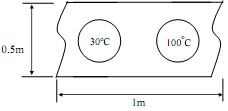
Due to the high velocity of the flow through pipes the temperature at the inside pipe walls can be assumed to be a constant 30oC for the cold pipes and 100oC for the hot pipes. The thermal conductivity of the material of the heat exchanger k = 0.3 W/m oC. Outside the concrete pipe, the surrounding air temperature is 25oC and the natural convection coefficient h = 0.2 W/m2 oC. Describe the model you would use (by exploiting the periodicity and symmetry of the problem) to find the temperature distribution in the cross-section and determine the maximum temperature on the outside surface of the pipe. Explain your assumptions. Use both a 2D and 3D model for comparison. Get reliable and affordable assignment help today!
Problem 2)
The frame shown in figure has a square cross section of 20x20mm2. The load P equal to a magnitude of 100N is applied at the center of the frame from both sides to squeeze it inwards. The Young's modulus of the material is assumed to be 200 GPa and Poisson' ratio equal to 0.3.
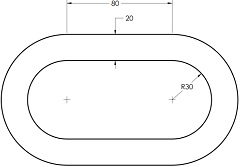
What is the appropriate model for this problem? (Make use of symmetry)
Compare solution with and without using symmetry.
Compare solutions using 2D versus 3D model for this problem. How close are the two solutions?