Reference no: EM132347836
Principles of Thermodynamics Assignment - Project Task
Overview: Your project task is to conduct a thermodynamic analysis of the Solar Turbines Mercury 50 packaged gas-turbine engine electric generator station. The manufacturer specifications are provided, and will be used to guide the thermodynamic analysis.
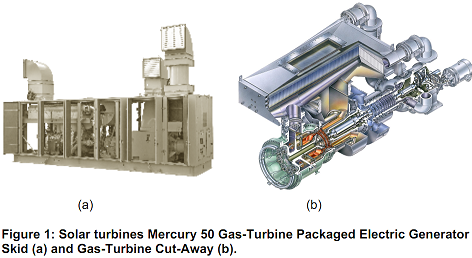
Task 1 - Gather System Data: Read the manufacturer's brochure, then locate and record the following system parameters: a) nominal inlet air flow rate (lbm/sec) temperature (oF) and pressure (psia), b) compression ratio (this is actually 'pressure ratio', rp), c) nominal electric power output (kW-electric or kWe), d) exhaust temperature (oF), e) after locating system data, convert inlet flow rate, temperature, pressure to kg/s, K, kPa. Also convert exhaust temperature to K.
Task 2 - Benchmark Firing Temperature: Assume that the Mercury 50 operates on an non-ideal regenerative Brayton cycle where the efficiencies of turbine, compressor are 85%, and the regenerator 0% (no heat transfer). Model the working fluid as air having constant mass flow rate, and as an ideal gas with variable specific heat (Table A-22). For this system determine a) the thermal efficiency (%), b) net power electric power produced (kWe) for assumed firing temperatures of 1000K and 1600K. These two assumed temperatures should result in power output that bounds (above and below) the actual system power output.
Task 3 - Converge the Implicit Problem: Repeat the cycle analysis of Task 2, but adjust the firing temperature so that system power output is 4.6 MWe ± 100 kW (4.59 to 4.61 MWe), and assume the regenerator effectiveness is 85%. Once the firing temperature is determined, report:
- Net Electric Power (kWe)
- Thermal Efficiency (%)
- Heat Rate (Btu/kW-hr)
- Firing Temperature (K)
- Exhaust Temperature (K)
- Mass Flow Rate (kg/s)
Deliverable: Submit a one page technical memo (typed), with the supporting calculations attached as separate pages. The memo should include:
1. Use a memo header and state brief summary of the project. The summary should address main results of the analysis, and comparison to manufacturers specifications. If possible, explain any differences.
2. A simple schematic of the system and T-s diagram. Use consistent numbering for the locations on schematic and T-s diagram.
3. A summary table state table listing results from Task 3.
|
Production costs and the corresponding drop in profits
: Why can a direct link not be drawn between an increase in production costs and the corresponding drop in profits?
|
|
Capital-employed analysis of the balance sheet
: When do we use a capital-employed analysis of the balance sheet? And when do we use a solvency-and-liquidity analysis of the balance sheet?
|
|
Price of the stock after the announcement
: Assuming that the discount rate remains the same, what will be the price of the stock after the announcement?
|
|
Is political jockeying an appropriate method in government
: Is political jockeying an appropriate method in government? Should it be present in the development of state budgets, executive activity, or legislative.
|
|
Conduct thermodynamic analysis of the Solar Turbines Mercury
: MEEN 315 Principles of Thermodynamics Assignment - Project Task, Texas A&M University, USA. Conduct thermodynamic analysis of the Solar Turbines Mercury
|
|
What is the price of the stock
: The appropriate discount rate for Pharsalus's stock is 14.6 percent. What is the price of the stock?
|
|
Yield to maturity on the bond
: Compute the price of a $ 8,602 par value, 17 percent coupon consol, or perpetual bond (i.e., coupon interest payment is a perpetuity)
|
|
Compute the? firm 2016 net operating income
: The interest rate on the? company's debt is 5.7 ?percent, and its tax rate 35 percent. The operating profit margin is 10 percent.
|
|
Defense of opposing argument
: Defense of Opposing Argument . Evaluate the quality of each argument, addressing whether key premises are true and whether the conclusion logically
|