Unit circle, Mathematics

Assignment Help:

Unit circle: The unit circle is one of the most valuable tools to come out in trig.  Unluckily, most people don't study it as well.

Below is the unit circle with just the first quadrant filled in is represented. The process the unit circle works is to draw a line from the center of the circle outside corresponding to a given angle. Then notify at the coordinates of the point where the line & the circle intersect. The first coordinate is the cosine of that angle & the second coordinate is the sine of that angle. We've put some of the basic angles along with the coordinates of their intersections on the unit circle.  Hence, from the unit circle below we can illustrates that cos (? /6 ) = √3 /2 and sin (?/6)= 1/2 .
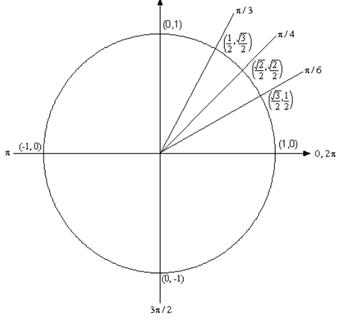
1143_unit circle.png

Keep in mind how the signs of angles work.  If you rotate into a counter clockwise direction the angle is +ve and if you rotate into a clockwise direction the angle is negative.

Remember as well that one complete revolution is 2 ? , thus the positive x-axis can correspond to either an angle of 0 or 2 ? (or 4 ? , or 6 ? , or -2 ? , or -4 ? , etc. based on the direction of rotation). Similarly, the angle ? /6 given angles: (to pick an angle totally at random) can also be any of the

? /6  +2 ? = 13 ?/6  (start at ? /6  then rotate once around counter clockwise)

? /6  + 4 ? = 25 ?/6  (start at ?/6  then rotate around twice counter clockwise)

? /6  -2 ?=11 ?/6 (start at ?/6      then rotate once around clockwise)

? /6  - 4 ? = 23 ?/6   (start at ?/6 then rotate around twice clockwise)

etc.

Actually ?/6 can be any of the given angles  ?/6 + 2 ? n , n = 0, ±1, ± 2, ±  3,.. In this case n refer to the number of complete revolutions you make around the unit circle begining at 6  .  Positive values of n correspond to counter clockwise rotations & -ve values of n correspond to clockwise rotations.

If you know the first quadrant then you can easily get all the other quadrants from the first along with a small application of geometry.


Related Discussions:- Unit circle

How does a child think-knowing your maths learner, HOW DOES A CHILD THINK? ...

HOW DOES A CHILD THINK? :  You must have interacted with children of various ages. From your experience, do you feel that children start learning, from a very early age, and conti

Shares and dividend, a man in rested rupee 800 is buying rupee 5 shares and...

a man in rested rupee 800 is buying rupee 5 shares and then are selling at premium of rupee 1.15. He sells all the shares.find profit

Application of derivatives, the base b of a triangle increases at the rate ...

the base b of a triangle increases at the rate of 2cm per second, and height h decreases at the rate of 1/2 cm per second. Find rate of change of its area when the base and height

Determine the area of the book jacket, A publishing company is creating a b...

A publishing company is creating a book jacket for a newly published textbook. Determine the area of the book jacket, given that the front cover is 8 in wide by 11 in high, the bin

Derivative and differentiation, Derivative and Differentiation The pro...

Derivative and Differentiation The process of acquiring the derivative of a function or slope or gradient is referred to as differentiation or derivation. The derivative is de

COS Sheets, How do I find percentages with doing COS Sheets

How do I find percentages with doing COS Sheets

Tangents, find a common tangent to two circles

find a common tangent to two circles

Describe common phrases to represent math operations, Describe Common Phras...

Describe Common Phrases to Represent Math Operations? The table below shows the common phrases used in word problems to represent addition, subtraction, multiplication, and div

Write Your Message!

Captcha
Free Assignment Quote

Assured A++ Grade

Get guaranteed satisfaction & time on delivery in every assignment order you paid with us! We ensure premium quality solution document along with free turntin report!

All rights reserved! Copyrights ©2019-2020 ExpertsMind IT Educational Pvt Ltd