Substitution rule, Mathematics

Assignment Help:

Substitution Rule

∫ f ( g ( x )) g′ ( x ) dx = ∫ f (u ) du,     where, u = g ( x )

we can't do the following integrals through general rule.
69_Substitution.png

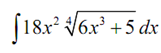
This looks considerably more difficult. Though, they aren't too bad once you illustrated how to do them.  Let's begin

69_Substitution.png

In this let's notice that if we let

                                                        u = 6 x3 + 5

and we determine the differential for this we get,

                                                              du = 18x2 dx

Now, let's go back to our integral & notice as well that we can remove every x which exists in the integral and write down the integral totally in terms of u by using both the definition of u & its differential.

   69_Substitution.png     = ∫ (6 x3 + 5)4  (18x2 dx )

                                         = ∫ u (1/4)  du

In the procedure of doing this we've taken an integral which looked very hard and with a rapid substitution we were capable to rewrite the integral in a very easy integral which we can do.

Evaluating the integral gives,

 69_Substitution.png  =          ∫u (1/4) du=(4/5)u(5/4)  + c =     (4/5)(6x3+5)(5/4)+c

As always we can verify our answer with a rapid derivative if we'd like to & don't forget to

"back substitute" & get the integral back into terms of the original variable.

What we've done above is called the Substitution Rule.  Following is the substitution rule in general.

A natural question is how to recognize the correct substitution. Unluckily, the answer is it totally depends on the integral.  Though, there is a general rule of thumb which will work for several of the integrals that we're going to be running across.

While faced with an integral we'll ask ourselves what we know how to integrate. Along the integral above we can quickly recognize that we know how to integrate

                                         ∫ 4  x dx

As a final note we have to point out that frequently (in fact in almost every case) the differential will not seems exactly in the integrand as it did in the example above & sometimes we'll have to do some manipulation of the integrand and/or the differential to obtain all the x's to disappear in the substitution.


Related Discussions:- Substitution rule

QM II, A HOSPITAL CURRENTLY ORDERS SALINE AT THE BEGINNING OF EACH MONTH. T...

A HOSPITAL CURRENTLY ORDERS SALINE AT THE BEGINNING OF EACH MONTH. THIS MONTH, THEY HAD 178 BAGS OF SALINE IN STOCK AND ORDERED 1,277 BAGS. DEMAND FOR SALINE IS NORMALLY DISTRIBUTE

Quadratic equations, Q UADRATIC EQUATIONS: For  the  things  of this  wor...

Q UADRATIC EQUATIONS: For  the  things  of this  world  cannot  be  made  known without  a  knowledge of mathematics. Solve by factorization a.    4x 2 - 4a 2 x +

Diameter of the circle , The length of the diameter of the circle which tou...

The length of the diameter of the circle which touches the X axis at the point (1,0) and passes through the point (2,3) is ? Solution)  If a circle touches the x-axis, its equatio

Trigonometric ratios, to difine trigonometric ratios of an angle,is it nece...

to difine trigonometric ratios of an angle,is it necessary that the initial ray of the angle must be positive x-axis?

Right angled triangle, In proving relation of trigonometric ratios we becam...

In proving relation of trigonometric ratios we became confused that what should we do next, so to complete any question quickly what should we do?

Function that computes the product of two matrices, Write a function that c...

Write a function that computes the product of two matrices, one of size m × n, and the other of size n × p. Test your function in a program that passes the following two matrices t

PDE, Consider the wave equation utt - uxx = 0 with u(x, 0) = f(x) = 1 if-1 ...

Consider the wave equation utt - uxx = 0 with u(x, 0) = f(x) = 1 if-1 ut(x, 0) = ?(x) =1 if-1 Sketch snapshots of the solution u(x, t) at t = 0, 1, 2 with justification (Hint: Sket

First and second order derivative, Solution : We'll require the first and s...

Solution : We'll require the first and second derivative to do that. y'(x) = -3/2x -5/2                                     y''(x) = 15/4x -7/2 Plug these and also the funct

Calculate the density of people per square mile, 1.  In 1900, a certain cou...

1.  In 1900, a certain country's population was 77,977,459 and it's area was 2,821,924 square miles, In 2000, the country's population was 283,575,229 and its area was 3,551,003 sq

Mod(z-25i)<15, Mod(Z-25i)   Sol) mod (Z-25i) means Z lies in the circumfer...

Mod(Z-25i)   Sol) mod (Z-25i) means Z lies in the circumference of the circle with (0,25) at its centre and radius less then 15. so difference in the max and min value of arg Z is

Write Your Message!

Captcha
Free Assignment Quote

Assured A++ Grade

Get guaranteed satisfaction & time on delivery in every assignment order you paid with us! We ensure premium quality solution document along with free turntin report!

All rights reserved! Copyrights ©2019-2020 ExpertsMind IT Educational Pvt Ltd